A U.S. bank account for non-residents may be available, but eligibility depends on the institution, account type and applicant’s circumstances. There is no single document package that guarantees approval at every bank. A passport, an EIN or a newly formed LLC answers only part of the bank’s questions.
First, distinguish between an account for an individual and an account for a business. A company application involves the legal entity, the people who own or control it and the people authorized to operate the account. Those roles may belong to different individuals.
Preparation should begin with the actual banking need and the institution’s current requirements. Explain where the applicant lives, what the business does and how the account will be used. Accurate information allows the bank to evaluate the application without relying on assumptions about a U.S. mailing address or an entity registration. Check those answers against the formation record and ownership details supplied with the application.
U.S. bank account for non-residents: what banks review
U.S. customer identification rules provide options for identifying non-U.S. persons. Depending on the customer, these can include a taxpayer identification number, a passport number with its country of issuance, or another qualifying government identification number. The bank determines how it verifies identity under its procedures and which applicants its products serve.
A bank’s policies may distinguish between residents and nonresidents, countries of residence, personal and business accounts, and in-person or remote applications. An account offered to one customer is not proof that another applicant will qualify under the same process.
The word “nonresident” also needs context. Immigration status, tax residence and the bank’s residency categories can differ. Do not choose a tax certification or describe legal status merely by copying the language used in a marketing page about foreign customers.
For business owners, a company formation record does not determine personal immigration rights. Our discussion of U.S. LLC ownership by foreign founders explains that ownership and permission to live or work in the United States are separate matters. Opening the account does not provide immigration permission.
Personal accounts and business accounts
A personal account identifies the individual customer. A business account identifies the legal business customer and the relevant people connected with it. The institution needs enough information to understand whose funds and transactions the account will handle.
For an LLC or corporation, the application may involve formation records, taxpayer identification information, current company details and proof of authority for the people signing. The bank may also need ownership and control information under its compliance procedures.
Do not assume that opening a personal account allows it to be used as the company’s operating account. The account agreement and the bank’s rules govern permitted use. Mixing personal and company transactions can also make accounting and records harder to maintain.
Similarly, the fact that a person owns the company does not necessarily establish every power to operate its accounts. The governing documents, decisions and institution’s authorization forms should agree. This is especially relevant when several members, managers or officers are involved.
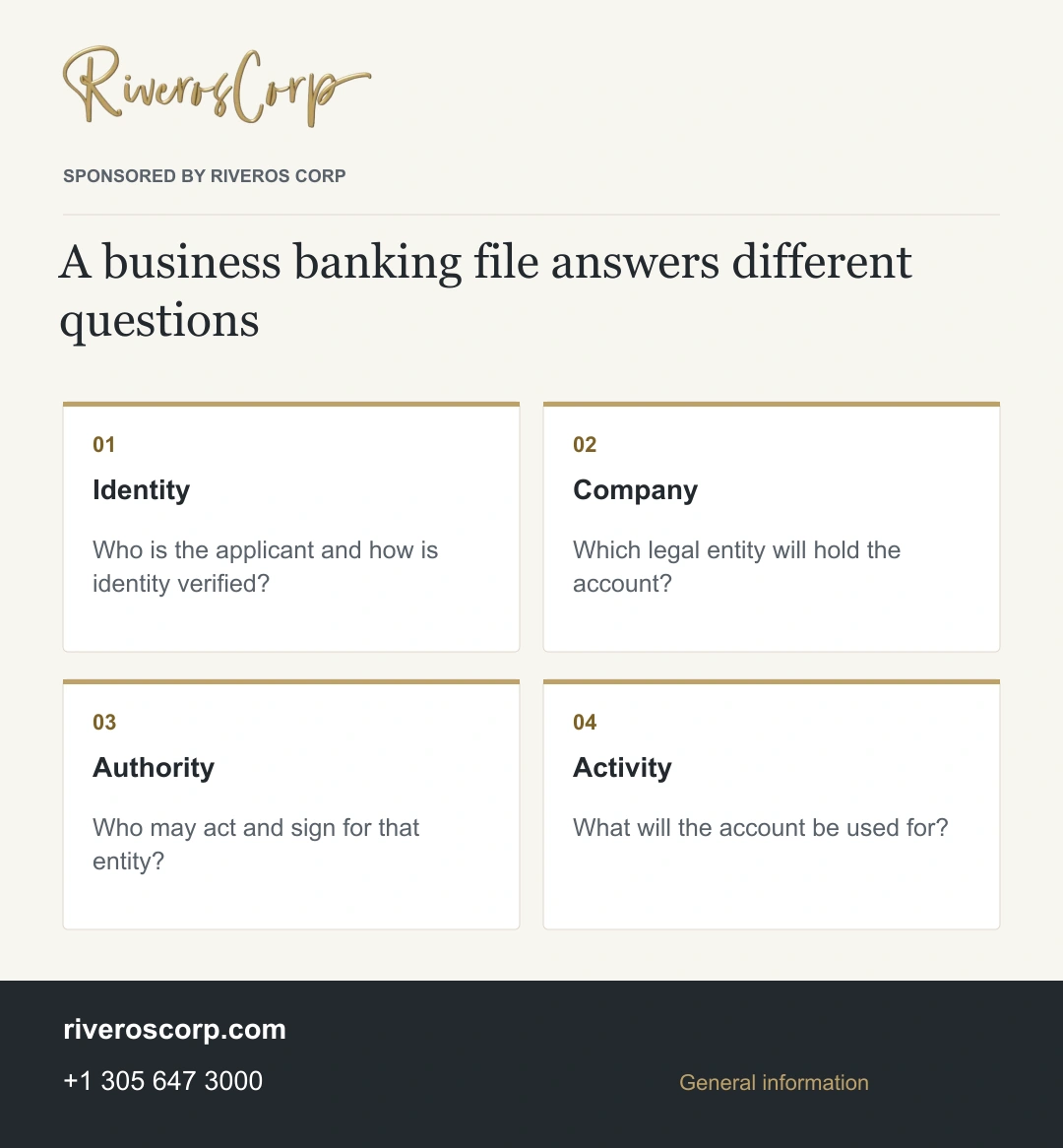
Identity and address information
A bank’s customer identification program collects basic information before opening an account: name, an individual’s date of birth, address and an identification number. The address rules distinguish an individual’s address from a legal entity’s principal place of business, local office or other physical location. The bank then uses its verification procedures to establish that it knows the customer’s identity.
A passport can support identity, but it does not necessarily answer every address or tax-status question. The institution may request additional evidence. Ask what it will accept for the actual applicant rather than assuming one country’s usual document is sufficient everywhere.
Addresses need accurate labels. A registered agent address, the company’s operating location, the owner’s residence and a mailing address may all differ. Presenting one as another can make the file inconsistent. Explain the arrangement instead of trying to make every field display the same address.
Names should also agree across documents, allowing for genuine differences such as transliteration or name order. Where records differ, identify the reason and the supporting evidence. Use the person’s correct name and explain any documented spelling or name-order differences.
EIN, ITIN and SSN serve different purposes
An EIN identifies an employer or other entity for federal tax administration. It is often part of a business banking file, but it does not establish every fact about the business or identify every owner. The bank still has to understand the customer and the people acting for it.
An ITIN is an individual tax processing number for a person who has a qualifying federal tax purpose and is not eligible for an SSN. It does not grant immigration status, authorize employment or function as general identification outside the federal tax system.
Do not assume every foreign applicant needs an ITIN solely to ask about a bank account. The institution’s requirements and the person’s tax circumstances must be considered separately. A request for a tax identification number should not lead to an application based on an invented tax purpose.
If the bank asks for evidence of the company’s EIN, provide the type of record it actually requests. Our article on official proof of EIN explains the distinction between knowing the number and supplying an appropriate IRS record. An old screenshot or a provider’s invoice may not answer the same request.
Why banks ask about ownership and activity
A bank needs to understand what the customer does and how the account will be used. For legal entity customers covered by the beneficial ownership rule, the review generally identifies individuals with at least 25 percent ownership and one individual with significant control, subject to the rule’s exclusions and exemptions. A bank can also request information under its broader risk procedures.
An applicant may need to describe its products or services, customers, operating locations and expected transaction patterns. A company with no completed transactions can explain its planned activity accurately. It should not invent customers, contracts or operating history to appear more established.
Beneficial ownership review for banking purposes is separate from filing a beneficial ownership report with FinCEN. A company should not assume that relief from one reporting regime prevents a bank from asking who owns or controls it. The institution has its own applicable duties.
FinCEN’s February 13, 2026 order lets covered institutions stop repeating beneficial owner identification and verification at every additional account opening. Under the relief, they may limit that step to the first account, later facts that call the earlier information’s reliability into question, and occasions required by their ongoing risk-based review. The order leaves their other applicable anti-money-laundering duties in place.
Remote applications and in-person requirements
Whether an applicant can complete the process remotely depends on the bank and account. Some institutions use remote identity verification, while others require an in-person appearance or impose additional conditions. Do not book travel or rely on a business launch date until the relevant requirements are clear.
Verification can involve documents, independent database checks, contacting the customer or a combination of methods. The federal framework specifically addresses accounts opened without the applicant appearing in person. A bank offering that route may need follow-up evidence before it is satisfied about identity, even if the passport itself is valid.
For a business with several owners or signers, confirm who must participate. One person’s presence may not resolve requirements for another person. The company should also clarify whether a representative may submit documents and which actions require the applicant’s own participation.
An online financial service should be evaluated according to what it actually offers. Do not assume that every platform using the word “account” is the same type of institution or product. Review the legal provider, account terms and disclosures relevant to the intended use before making a business decision.
Why an application may need more review
Incomplete or inconsistent information can prevent the bank from forming a reliable view of the customer. Examples include company names that do not match, expired identification, unexplained ownership changes or a business description inconsistent with the supporting records.
The institution may also decide that a proposed relationship falls outside its current policies. That is different from a document preparation error. A service provider cannot promise acceptance by correcting a form if the institution does not offer the requested account to that applicant.
If the bank asks for clarification, respond to the actual question. Sending a larger pile of unrelated documents can obscure the issue. Keep a record of what was requested, what was supplied and which points remain open.
A declined application does not justify changing material facts for the next one. The company’s identity, ownership and activities must remain accurate. Where an issue involves tax status, legal authority or sanctions restrictions, seek the appropriate professional advice rather than treating it as a wording problem.
Which bank is best for a foreign owner?
Start with the service the account must support. A foreign owner receiving client payments may need different features from a company paying employees or suppliers. Compare current applicant eligibility, supported currencies, payment methods and user permissions. The institution also needs to know the owner’s country of residence and the company’s actual activity before it can assess the proposed relationship.
Consider what the business actually needs to do after opening. Receiving customer payments, paying suppliers and giving staff controlled access may involve different features and documentation. An account that can be opened is not necessarily suitable for the intended operations.
Ask the institution directly about the proposed arrangement. A provider’s statement about a prior client’s account does not establish today’s eligibility. Policies can change, and an individual approval does not create a general entitlement for similar businesses.
Keep bank selection separate from company structure advice. Forming another entity solely because someone claims it will guarantee banking can create obligations without delivering the promised result. Review the legal structure, tax consequences and institution’s actual requirements before making that change.
How Riveros Corp supports preparation
Riveros Corp helps prepare the documents for a U.S. business bank account. The service covers company records, a resolution naming authorized signers, ownership documentation and a description of the business. This is business-account support; a personal account request should be discussed directly with the institution offering that product.
Gather the formation record, current company information, relevant tax identification evidence and documents showing signing authority. Explain any recent changes so that an older record is not presented as the current situation. The exact package depends on what the institution asks for.
Give the team the bank’s written request and identify any recent ownership, management or address change. The preparation can then focus on missing or inconsistent records instead of assembling unrelated paperwork. The bank reviews the completed application and controls its decision. Questions about the applicant’s tax status or a disputed right to act for the company require the appropriate professional review.
Frequently asked questions
Can a non-resident open a U.S. bank account without an SSN?
Possibly, depending on the institution, account and applicant. The identification framework recognizes other information for non-U.S. persons, but banks apply their own lawful policies. Confirm the actual requirements before assuming a passport or ITIN alone will be enough.
Does an EIN guarantee a business account?
No. An EIN is one piece of tax identification information. The bank may also review company existence, authority, ownership, personal identification and expected activity. It decides whether the application meets its requirements.
Do I need to travel to the United States?
That depends on the institution and account. Some processes allow remote participation and others require an appearance or additional verification. Confirm who must participate and which documents are acceptable before making travel arrangements.
Which U.S. bank is best for foreigners?
There is no single best bank for every foreign applicant. Evaluate current eligibility and the services needed for the actual business. Ask the institution about the proposed relationship rather than relying on a general recommendation or another person’s approval.
What can Riveros Corp help prepare for a business account?
Riveros Corp can help organize the company documents, ownership information, authorized-signer resolution and description of the business within the agreed service scope. The applicant supplies the underlying facts. The financial institution conducts its own review and decides whether to open the account.
Prepare a clear company banking file
Contact Riveros Corp at +1 305 647 3000 to discuss the documents for your business banking request. Identify the account type, entity and institution requirements already received.
General information, not legal or tax advice for a particular situation. By Zulma E Bourelly.