The PLLC vs LLC question starts with the service the business will provide. A professional limited liability company is an LLC organized to render a specific professional service under the applicable state law. It adds professional licensing and ownership requirements to the ordinary entity framework.
In Florida, professional service companies are addressed by Chapter 621 together with the relevant LLC provisions in Chapter 605. The professional rules matter to who may own the business, who may provide the service and what happens when a person becomes disqualified to practice.
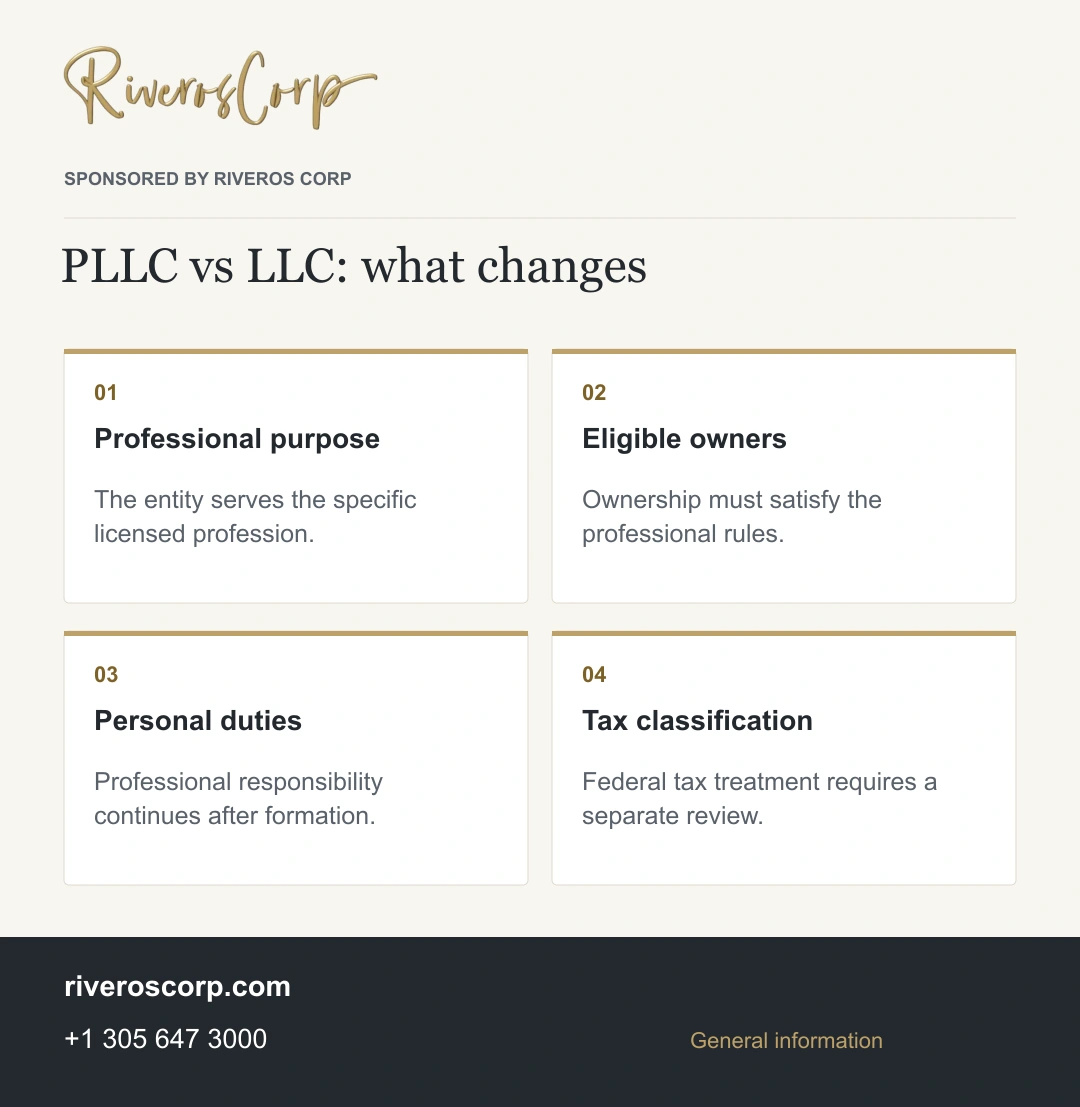
A PLLC is not a way to obtain a professional license through company formation. It also does not remove personal responsibility for a professional’s own negligent or wrongful work. Before selecting an entity name, owners need to review the profession, licensing rules, proposed owners and actual scope of the practice. Tax classification needs a separate review. The professional designation alone does not determine how the company will be taxed.
What is a PLLC?
Florida defines a professional limited liability company as an LLC organized under Chapter 621 for the sole and specific purpose of rendering professional service. Its permitted members must meet the applicable professional eligibility requirements. That purpose limits what the company is organized to do.
The chapter defines professional service by reference to personal services for which a license or other legal authorization is required. It lists examples, including law, medicine, dentistry, accounting and architecture, without making that list exhaustive. A particular profession may also have rules administered by its own licensing authority.
An ordinary LLC can be used for many lawful businesses, but that does not mean every licensed practice may choose an ordinary form without further review. The professional statute, profession-specific law and regulator’s requirements must be considered together.
Florida’s rules also explain which law controls. Chapter 605 supplies the general LLC framework, while Chapter 621 controls when its professional provisions conflict with that framework. A profession’s own licensing rules can add requirements. This is why a formation record and a professional authorization need to be checked together even though different agencies may issue them.
PLLC vs LLC: the main differences
Both forms use the LLC structure, but the professional form adds restrictions tied to licensed services. In Florida, the professional company’s purpose and member eligibility are narrower than an unrestricted commercial business model. These requirements affect formation and later changes in ownership.
A proposed investor must satisfy the professional ownership rules before admission as a member. Family relationship or a contribution of capital does not supply the required professional qualification. The same review applies to a transfer after formation: the operating agreement should reflect the restrictions instead of promising that an interest can be transferred freely to anyone.
Section 621.12 provides naming options. For a professional LLC formed on or after January 1, 2014, the listed professional LLC designations include ‘professional limited liability company,’ ‘P.L.L.C.’ and ‘PLLC’ in place of the ordinary LLC designation; the statute also allows ‘chartered.’ Older professional LLCs have additional listed options. The practice must still check any naming rules imposed by its licensing authority.
The ordinary LLC obligations continue to matter as well. Professional status does not eliminate the registered agent, annual report or internal governance work. Our overview of corporations and LLCs explains the underlying entity differences before the additional professional requirements are considered.
Which professionals should review these rules?
Anyone planning to provide a service that requires a professional license should ask whether the proposed business structure is permitted for that practice. The answer should come from the governing law and licensing authority, not simply from whether a filing website accepts an entity name.
Do not interpret the existence of Chapter 621 as a statement that every licensed individual in Florida must form a PLLC. A professional may have permitted alternatives, and the profession may impose its own restrictions. The task is to identify the lawful options for the actual activity.
The same review applies to a team. Owners may hold different licenses, or one proposed investor may not be licensed at all. Florida’s professional LLC provisions focus on persons or qualifying entities authorized to render the same specific professional service. A mixed practice or ownership plan deserves careful legal analysis.
An overseas qualification is another separate issue. Having trained or practiced in another country does not establish authorization to render the profession in Florida. Company formation cannot supply the professional permission that the individual or practice still needs.
Ownership and professional eligibility
Florida Chapter 621 limits membership in a professional LLC to the qualifying persons or professional entities described in the statute. The restriction is relevant both when the company is formed and when an interest is later transferred. A general LLC transfer clause cannot be assumed to override it.
The company should know who its proposed members are and what authorizes them to provide the relevant professional service. It should also distinguish ownership from employment. A person may work in an administrative role without being eligible to own the professional entity under the same terms.
Section 621.06 allows professional services to be rendered through persons who are properly licensed or otherwise legally authorized. It also distinguishes clerical and other supporting roles that do not ordinarily constitute the licensed service. That distinction prevents the mistaken claim that every receptionist or bookkeeper must hold the professional license.
A change in eligibility can require action immediately. Section 621.10 addresses a person rendering professional services who becomes legally disqualified or accepts employment that legally restricts continued practice: that person must sever employment and financial interests in the professional entity. A planned departure or licensing problem therefore needs attention under both the statute and the governing agreement.
Liability: what the PLLC does not erase
Florida’s professional entity law preserves the legal relationship and professional duties between the person rendering the service and the recipient. Section 621.07 addresses personal responsibility for negligent or wrongful acts or misconduct by that person, and by a person under their direct supervision and control while rendering professional services.
The entity itself is liable, up to the full value of its property, for covered negligent or wrongful acts committed in the course of rendering its professional services. At the same time, section 621.07 limits a person’s responsibility in the capacity of shareholder or member by reference to the ordinary corporate or LLC rules. Personal conduct and ownership alone are different bases for evaluating liability.
Ordinary business liabilities and professional liabilities raise different questions. A lease, an employment issue, a personal guarantee and a claim arising from professional services may not be analyzed in the same way. The facts, documents and applicable law determine the exposure.
Insurance is also a separate matter. The professional should review required and appropriate coverage with the relevant advisers. A company filing does not substitute for professional insurance, risk management or compliance with the standards of the profession.
PLLC vs PA in Florida
Florida also recognizes professional corporations, commonly identified with the PA designation. A professional corporation uses a corporate structure, while a PLLC uses an LLC structure. Both must be evaluated under the professional service rules that apply to their purpose and participants.
The choice affects governance documents and roles. A corporation generally uses articles of incorporation, bylaws, directors and officers. An LLC uses articles of organization and an operating agreement, with management structured under the applicable law and agreement.
Do not choose PA or PLLC solely because one abbreviation looks more familiar to clients. The ownership plan, management arrangement, professional rules and tax analysis should be considered together. The appropriate advisers can explain the consequences for the actual practice.
Our comparison of articles of incorporation and articles of organization clarifies the basic filing distinction. Licensing approvals and tax elections must be addressed separately from that filing.
Tax treatment is a separate decision
PLLC is a state-law professional designation. It does not by itself create a separate federal income tax category. The federal treatment of an LLC depends on factors such as the number of members and any valid tax election, subject to the relevant rules.
For federal purposes, an LLC may fall under default disregarded-entity or partnership treatment, or elect corporate treatment when permitted. That general framework does not mean every election is available or advisable for every professional practice and owner.
An S corporation election has its own eligibility requirements. An owner’s tax residence and the entity’s ownership structure can affect eligibility. An S corporation cannot have a nonresident alien shareholder. The entity suffix should not be used as a shortcut to promise a tax benefit or assume qualification.
A tax professional should review the intended activity, owners and compensation arrangements. Keep that analysis separate from the state formation decision. Filing a professional LLC and making a federal tax election are different acts, and one should not be assumed to complete the other.
Questions to settle before formation
Identify the exact professional service and where it will be rendered. Then determine the applicable licensing authority and the rules governing the practice entity. An entity may be allowed under general business law while still needing additional professional registration or authorization.
Review the proposed owners and managers against those rules. Clarify who will provide professional services, who will supervise work and who will handle administration. The governing agreement should fit the lawful structure rather than rely on assumptions copied from an ordinary business template.
The agreement should also address permitted ownership changes and events affecting eligibility. Our article on the purpose of an LLC operating agreement explains why the internal document matters. For a PLLC, that document must also account for professional restrictions.
Finally, distinguish formation readiness from readiness to practice. Name acceptance, an EIN and a state entity record do not necessarily mean the professional service may begin. Licensing, insurance, facility or other activity-specific issues may still need to be completed.
Riveros Corp and the formation documents
Riveros Corp provides PA and PLLC formation support in Florida. Its published service includes preparing and filing formation records, the registered-agent arrangement and the internal governing document. The profession, licensing jurisdiction and proposed members determine what information the team needs before preparing those records.
Questions about which entity is legally permitted, professional liability or the terms of an ownership arrangement should be reviewed by qualified counsel. Tax classification decisions should be reviewed with a tax professional. Document support does not replace those decisions or grant a professional license.
Once the structure and required approvals are established, use the same legal name and professional description across the accepted filing and governing documents. Keep licensing evidence with those records. If the company later leaves professional practice, section 621.13 provides a change-of-purpose route; an accepted amendment removes the entity from Chapter 621, including its right to practice through that professional entity.
Frequently asked questions
Is a PLLC still an LLC?
Yes. It uses the LLC structure with additional professional-service requirements under the applicable state law. In Florida, Chapters 605 and 621 work together. The professional purpose, permitted members and licensing rules need attention beyond a general LLC filing.
Does every licensed professional in Florida have to form a PLLC?
Do not assume that. The profession’s laws and licensing authority determine the available structures and requirements. A PLLC is one professional entity form, but the appropriate option must be checked for the actual practice.
Does a PLLC protect me from my own malpractice?
It does not remove responsibility for your own negligent or wrongful professional conduct. Florida law also addresses conduct by people under direct supervision and control. Ask an attorney about the actual exposure and review insurance separately.
Is a PA the same as a PLLC?
No. A PA is a professional corporation, while a PLLC is a professional limited liability company. Their governance structures differ, even though both may be subject to professional-service restrictions.
Do all states recognize professional LLCs in the same way?
No. Available professional entity forms and ownership rules vary by jurisdiction and profession. A Florida structure should not be assumed valid for practice elsewhere. Check the destination state’s current law and licensing requirements before expanding.
Start with the profession and the proposed owners
Contact Riveros Corp at +1 305 647 3000 to discuss formation document support for a professional practice. Identify the service and jurisdiction before selecting the entity form.
General information, not legal or tax advice for a particular situation. By Zulma E Bourelly.