An EB-4 visa may provide a route to permanent residence for a qualifying religious worker. Eligibility depends on both the person and the proposed religious work. A church’s willingness to sponsor someone, or its recognition as a tax-exempt organization, does not by itself establish that the petition qualifies.
The worker’s denominational membership, previous work, proposed duties and compensation all matter. The organization also needs records showing its religious character, qualifying nonprofit status and ability to support the position. These records should describe the actual arrangement rather than a position created only on paper.
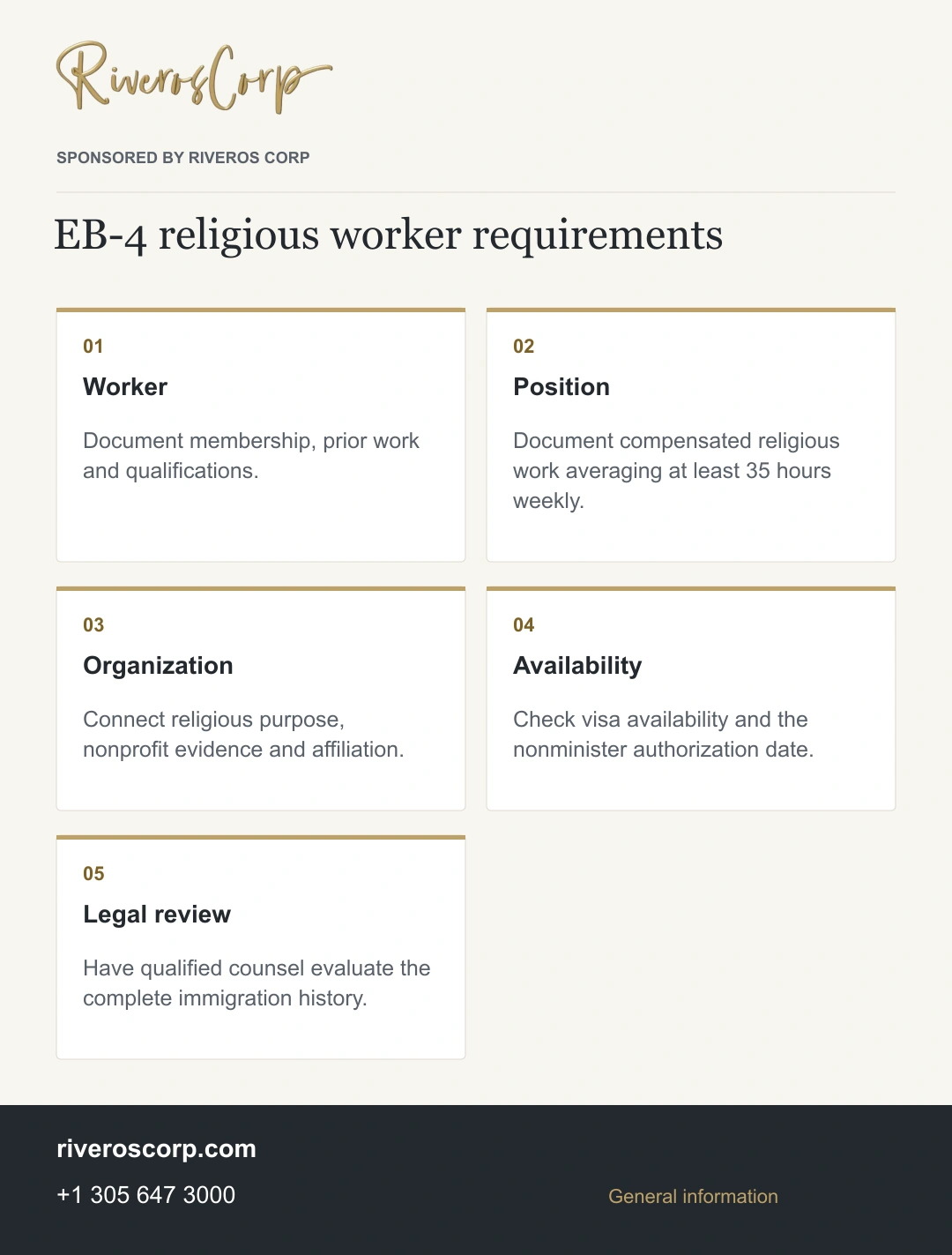
There is also a date-sensitive distinction between ministers and other religious workers. As reviewed on November 10, 2026, the special immigrant program for qualifying nonminister religious workers is authorized through December 11, 2026. Organizations considering that route should have an immigration attorney check the current authorization and visa availability before acting.
An approved petition does not by itself grant permanent resident status.
What an EB-4 visa means for a religious worker
EB-4 is an employment-based immigrant category that includes several kinds of special immigrants. Religious workers are one part of that category. The religious worker petition uses Form I-360. The worker or the prospective U.S. employer may file it, but the employer must still provide the required attestation and organizational evidence.
Petition approval establishes the religious worker classification. Permanent residence requires the appropriate immigrant visa or adjustment process, subject to the remaining eligibility requirements and visa availability. A worker abroad usually proceeds through consular processing; a worker in the United States must separately establish eligibility to adjust status.
An approved I-360 therefore does not set an employment start date. The priority date and the applicable Visa Bulletin affect when an immigrant visa may be available. The worker’s current immigration status and authorization to work remain separate questions while the immigrant process is pending.
Denominational membership and previous religious work
The regulations generally require membership in the relevant religious denomination for at least the two years immediately before the petition. They also require qualifying religious work during the required preceding period, subject to rules governing that work and certain breaks.
Membership and employment are different facts. A person may have attended a congregation for years without having performed the qualifying work required for the petition. Conversely, a worker’s job records may establish duties without clearly documenting denominational membership. A file needs evidence addressing each requirement separately.
Useful records can include membership confirmations, appointment letters, compensation records and descriptions of actual duties. Dates should agree across the worker’s history and the organization’s records. An attorney should evaluate gaps, unpaid arrangements and work performed in the United States under the applicable law. A general checklist cannot resolve those issues, and past immigration status should never be guessed from a religious organization’s letter.
Ministers, religious vocations and religious occupations
The category distinguishes ministers from workers in religious vocations and religious occupations. A minister’s evidence must address authorization to conduct religious worship and perform the duties recognized by the denomination. The applicable training and ordination requirements depend on that denomination; a particular academic degree is not a universal substitute for those requirements.
A religious vocation involves a formal lifetime commitment to a religious way of life, such as the commitments associated with certain monks or nuns. A religious occupation involves duties that primarily relate to a traditional religious function recognized within the denomination.
Working for a church does not automatically make a job religious work. Primarily clerical, maintenance, fundraising or administrative positions do not become qualifying religious occupations because the employer is religious. Incidental administrative work may be compatible with an otherwise qualifying position. The central question is what the person will actually do, supported by a credible description and organizational records.
The proposed position must be real and documented
The position must provide compensated work averaging at least 35 hours per week. The file should explain duties, working hours, location and compensation in terms that match the organization’s operations. A generic title such as “missionary” or “religious director” does not establish the substance of the job.
Compensation can raise practical documentation questions when the arrangement includes housing, meals or other nonsalaried support. Those arrangements require evidence. A promise that members of the congregation will help the worker is different from records showing how support is arranged and funded.
Sponsors should also distinguish the proposed position from the worker’s prior service. Evidence of earlier work does not prove that the future position meets the requirements. A clear file explains both periods without merging them. Where several locations or organizations are involved, an attorney should assess the arrangement before anyone assumes that a single letter adequately describes it.
What the sponsoring organization must establish
The organization must be a qualifying nonprofit religious organization in the United States or a qualifying organization affiliated with the denomination. The regulation requires a current IRS determination letter. A religious organization covered by a group exemption can use the group determination letter. An affiliated organization recognized as something other than a religious organization needs additional evidence of religious purpose and denominational affiliation.
The employer’s attestation includes the number of members, employees at the proposed work location, relevant religious worker employment and petition history for the preceding five years, daily duties and the compensation package. These are factual statements about the organization. Membership lists, payroll records and previous filing records help its authorized official answer them accurately.
Our explanation of nonprofit articles of incorporation describes the entity’s formation documents. Those documents should identify the same entity that offers the position. If a ministry uses a different public name or belongs to a larger denomination, the file should explain that relationship and include the records supporting it.
Why tax exemption alone does not establish sponsorship eligibility
Tax-exempt status addresses a tax classification. Religious worker eligibility involves a separate set of immigration requirements. An organization can have relevant tax documentation while still lacking a qualifying position, adequate compensation evidence or the organizational relationship required for a particular petition.
Religious organizations can have different exemption records. Individual recognition, group arrangements and affiliation structures require careful attention to the evidence accepted under the regulation. An informal statement that a church is “automatically exempt” should not be treated as a replacement for the documentation required in the immigration file.
Our discussion of 501(c)(3) articles of incorporation explains the organizational purpose of those provisions. For immigration purposes, an attorney should connect the sponsor’s actual tax and governance records to the applicable requirements. Rewriting a corporate document cannot cure a missing religious employment relationship or establish facts that do not exist.
The current distinction for nonminister religious workers
The authorization for qualifying nonminister religious workers has a statutory expiration date. The October 2026 Visa Bulletin reports an extension through December 11, 2026. The November 2026 bulletin continues to list the applicable special immigrant religious worker category, subject to visa availability.
That authorization date is not a promised approval date or a prediction that Congress will extend the program again. It also should not be confused with the Visa Bulletin’s final action dates. Statutory authorization and availability of an immigrant visa are separate questions, and both can affect a case.
The minister category must be distinguished from the temporary authorization applicable to nonminister religious workers. A worker’s title does not decide that distinction by itself. An attorney needs to evaluate whether the duties and denominational credentials meet the minister definition. Organizations should not change a title merely to try to avoid a program deadline.
EB-4 and R-1 serve different immigration purposes
R-1 is a temporary religious worker classification. EB-4 religious worker classification concerns an immigrant route. A person’s history in R-1 status may be relevant evidence, but holding R-1 status does not automatically establish eligibility for EB-4 or eliminate the need for a separate petition and subsequent process.
The two classifications have their own requirements, procedures and timing issues. A sponsor should avoid treating an R-1 approval as permission to make any change in the worker’s duties, employer or immigration plans. Those changes may require legal review, particularly when temporary status and a pending immigrant process overlap.
Compare the proposed position with the requirements of each classification. Workers should ask qualified counsel how the proposed position, previous work, present location and immigration history affect the available options. An organizational document service cannot make that legal determination.
Assemble the organization’s records for legal review
Keep the governing documents, IRS determination evidence, denominational affiliation records and compensation evidence together. For the worker, distinguish membership records from previous employment records. If a legal name changed, retain the amendment or other document establishing the change so an older letter can be connected to the current entity.
USCIS may verify the organization’s evidence through an on-site inspection. The regulation allows review of premises, interviews with officials and examination of selected records. When USCIS chooses a preapproval inspection, satisfactory completion is a condition of approval. The organization should be able to explain its actual operations and locate the records supporting its attestation.
Riveros Corp’s EB-4 sponsor preparation service works on the organization’s side of that file. Its services include entity records, IRS recognition documentation and the evidence needed to describe the proposed position and compensation. An immigration attorney or accredited representative handles the worker’s eligibility, immigration strategy and representation; Riveros Corp does not provide that representation.
Frequently asked questions
Who can qualify for an EB-4 religious worker visa?
Eligibility depends on the religious worker classification, including qualifying denominational membership, previous work, the proposed position and the sponsoring organization. Ministers and certain other religious workers are covered by different statutory conditions. Being employed by a church or having a religious title is insufficient on its own. An attorney should evaluate the complete facts.
Is an approved EB-4 petition the same as a green card?
No. Petition approval addresses classification. Permanent residence requires the applicable immigrant visa or adjustment process and satisfaction of the remaining requirements. Visa availability can affect when that process moves forward. Approval should not be treated as a guarantee of admission, work authorization or a particular start date.
Can a tax-exempt church sponsor any employee?
No. Tax exemption does not turn every church job into qualifying religious work. The position, worker and organization must meet the applicable requirements. Primarily maintenance or clerical duties, for example, do not become religious duties simply because the employer is a church. Evidence must reflect the real position.
How long does the EB-4 process take?
There is no reliable universal completion date. Petition processing, requests for evidence, visa availability and the person’s subsequent immigration process can each affect timing. Nonminister workers must also consider the current statutory authorization. An attorney can assess the relevant constraints without promising when the government will decide a case.
Does the worker or the religious organization file Form I-360?
The religious worker or the prospective U.S. employer may file the petition. Either way, the employer must provide the required attestation and supporting organizational evidence. A self-petition does not remove the requirement for a qualifying U.S. position, compensation or a qualifying organization. The filing arrangement should match the actual employment relationship.
Discuss your religious organization’s documents
Contact Riveros Corp at +1 305 647 3000 or through WhatsApp to discuss your religious organization’s records, IRS determination evidence and sponsor documentation. Bring any existing determination letter and the organization’s legal name so the team can identify what is already available and what needs preparation.
By Zulma E Bourelly. General information only. Individual legal and tax questions require advice from an appropriately qualified professional.