What is FATCA? The Foreign Account Tax Compliance Act is a U.S. tax compliance framework addressing certain foreign financial accounts and assets. It includes reporting rules for foreign financial institutions and certain other entities, as well as reporting obligations for specified U.S. taxpayers.
For many people, the first encounter with FATCA is a bank request for a tax identification number or a tax-status certification. That request does not automatically mean the person owes U.S. tax or has committed an error. The institution needs information to determine how its reporting and withholding rules apply.
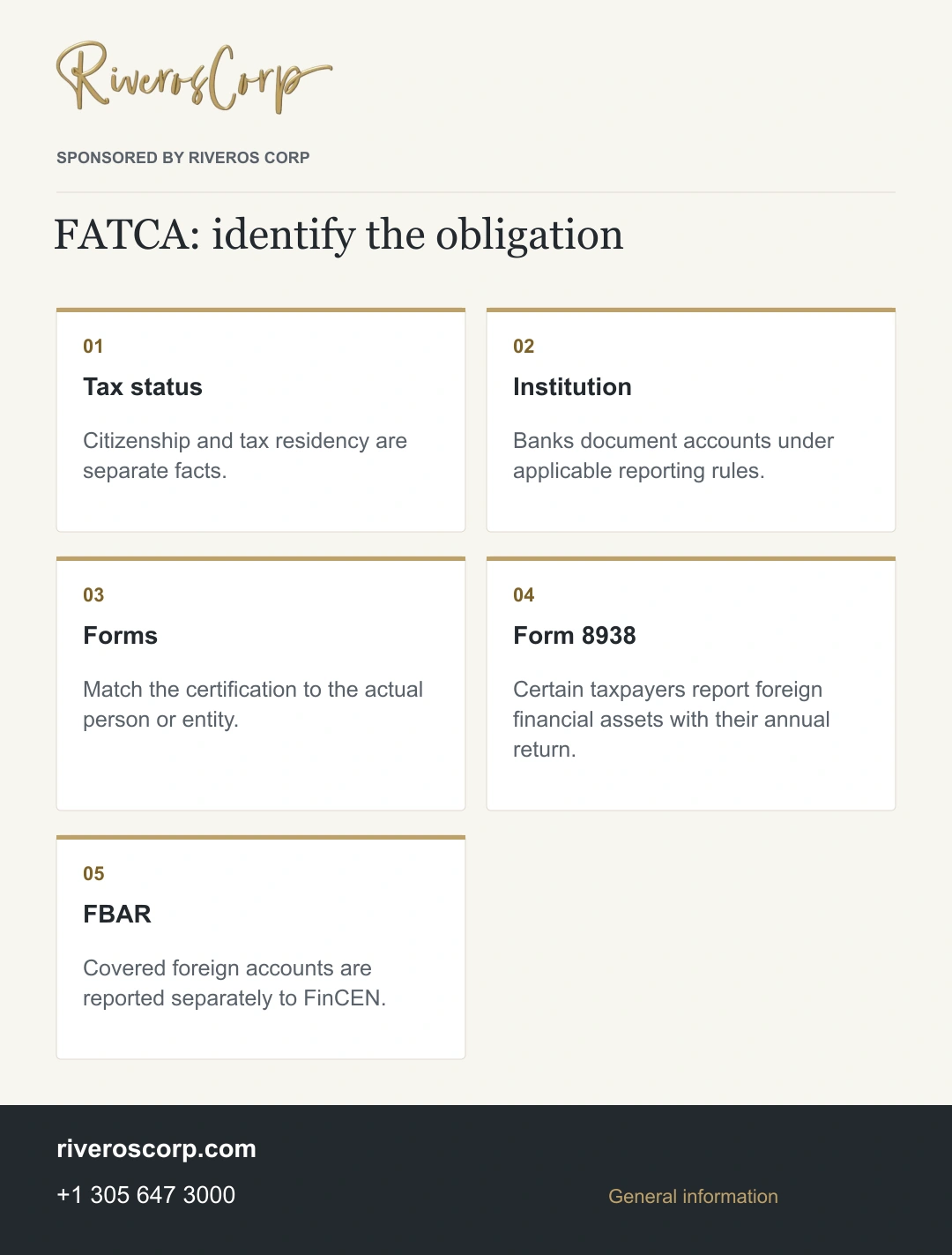
The account holder’s tax status and ownership facts determine which rules apply. Citizenship can matter, but it is not the only factor. A foreign citizen can be a U.S. tax resident, and a U.S.-organized company does not become a foreign entity merely because its owner lives abroad.
Form 8938 may apply to an individual’s foreign financial assets. FBAR has separate reporting rules; filing one report does not automatically satisfy the other.
What is FATCA intended to identify?
FATCA helps identify financial accounts held outside the United States by specified U.S. persons and certain entities with relevant U.S. owners. Foreign financial institutions document the account holder’s status and report covered accounts under the rules that apply to them. The institution’s report is one part of the law.
Another part requires certain taxpayers to report specified foreign financial assets on Form 8938. The institution and the taxpayer therefore have different responsibilities. A bank’s report does not replace a taxpayer’s required form, and receiving a bank questionnaire does not establish that the customer must file Form 8938.
The first task is to identify what the request concerns. A bank may need a certification for an account, while a return preparer needs information about all reportable foreign financial assets for the year. Keep the institution’s request with the account records, and distinguish it from the documents needed to prepare an annual tax return.
Why a bank asks questions before deciding what to report
Banks collect tax-status information to classify accounts and identify relevant account holders or owners. A request may arise when an account opens, when the institution reviews existing records or when information changes. The request is part of the institution’s compliance process.
A U.S. address or other information in the account records may lead the bank to ask for clarification. The customer should respond with accurate documents rather than assume that the request itself establishes a tax conclusion. A record can contain outdated information, or facts may require explanation.
Our overview of customer due diligence requirements explains why institutions ask for identity and ownership records. FATCA tax documentation serves a particular purpose within that broader account review. It should not be confused with a criminal investigation or treated as evidence that every requested customer is suspected of wrongdoing.
Citizenship, immigration status and tax residency are different
U.S. citizens generally have U.S. tax responsibilities while living abroad. Noncitizens can also be resident aliens for federal tax purposes. The general residency tests concern lawful permanent residence and substantial physical presence, with exceptions and treaty rules that can affect a particular case.
The substantial presence test uses days from the current year and the preceding two years with different weights. It is not simply a count of whether someone spent half of the current year in the United States. Some days do not count under specific rules. A travel history and immigration documents give a tax professional the facts needed to apply those rules.
The institution’s certification should reflect the resulting tax status. A foreign passport does not establish nonresident status by itself. If the relevant facts changed after an earlier certification, tell the institution and have the documentation reviewed rather than copying the old answer into a new form.
W-9, W-8BEN and W-8BEN-E document different tax statuses
Form W-9 generally documents a U.S. person’s taxpayer information. Form W-8BEN generally documents the foreign status of an individual beneficial owner for relevant withholding and reporting purposes. For specified foreign entities, Form W-8BEN-E applies subject to the detailed rules and exceptions.
The choice depends on the actual payee and tax status. An individual cannot simply use the entity form because the account relates to business activity. Likewise, a foreign shareholder’s nationality does not automatically make a U.S. corporation eligible to certify itself as a foreign entity.
These forms ordinarily go to the requesting institution or withholding agent, rather than being filed as a substitute for the person’s annual tax return. They contain certifications with legal significance. If the bank’s request appears inconsistent with the entity structure or taxpayer status, ask for clarification and obtain professional review before signing.
Foreign-owned U.S. entities require careful classification
A U.S.-organized company and its foreign owner are different subjects. The entity’s place of organization, federal tax classification and ownership determine which documentation may be appropriate. A foreign-owned domestic corporation ordinarily does not become foreign for documentation purposes solely because of its shareholder.
Disregarded entities require additional care because the tax rules may look to the owner for particular purposes. The account title, legal entity and tax owner can therefore require a coordinated explanation. Selecting a W-8 form based only on a foreign mailing address can be incorrect.
Our guide to foreign ownership of a U.S. LLC explains the formation context. For FATCA documentation, have a qualified professional review the actual tax classification. Formation records establish useful facts, but they do not answer every question about beneficial ownership or the correct certification.
Institutional reporting may operate through an agreement
The United States has intergovernmental agreements with many jurisdictions for implementing FATCA. The applicable agreement can affect whether a financial institution reports through its local tax authority or directly under the relevant U.S. framework.
This helps explain why a customer at a non-U.S. bank may receive questions referring to both local law and U.S. tax status. Read the request in the context of the institution and jurisdiction; banks do not all use an identical procedure.
The existence of an agreement does not eliminate the need for accurate customer information. Nor does it establish that a customer has no personal filing obligation. Ask the institution what documentation it requires, and ask a tax professional about the account holder’s own duties. The bank confirms its document requirements; the tax professional determines the customer’s filing duties.
Which assets can belong on Form 8938?
Form 8938 applies to specified individuals and specified domestic entities with interests in covered foreign financial assets when the filing conditions and applicable thresholds are met. The form goes with the taxpayer’s annual return. If the taxpayer has no requirement to file that return, the IRS says Form 8938 is not required for the year.
Foreign financial accounts are part of the analysis, but certain assets held outside an account can also count. Examples include foreign stocks held directly and interests in foreign partnerships. By contrast, directly owned foreign real estate is not itself a specified foreign financial asset. An interest in a foreign entity that owns real estate can be reportable, so the ownership arrangement matters.
The applicable threshold depends on the taxpayer category and, for individuals, circumstances such as residence and filing status. The review needs ownership records and asset values, not merely the balance of one bank account. Keep account statements and records of directly held investments together so the preparer can evaluate the complete set of relevant assets.
FATCA reporting and FBAR are separate requirements
FBAR refers to the Report of Foreign Bank and Financial Accounts, filed with FinCEN under a separate legal framework. It is not another name for Form 8938. The two requirements have different coverage, thresholds, filing methods and definitions.
A person may need one, both or neither, depending on the facts. Filing an FBAR does not automatically satisfy Form 8938, and attaching Form 8938 to a tax return does not replace a required FBAR. A bank’s FATCA report also does not substitute for either personal obligation.
The review should therefore identify the account holder’s financial interests, any relevant signature authority and the assets covered by each regime. Avoid asking only whether “FATCA was filed.” That phrase can conceal several different tasks. The completed records should identify the actual form, reporting year and evidence of submission for each required filing.
Ownership and business records support the review
For an individual, useful records may include tax identification information, residence history, account statements and earlier certifications. For an entity, the review may require formation documents, ownership records, tax classification evidence and information about the entity’s activities.
The records should describe the same person or entity consistently. Explain name changes, reorganizations and different mailing addresses rather than allowing the institution to guess how they relate. A beneficial ownership chart can help organize facts, but underlying records should support it.
Our discussion of company due diligence explains why a clear ownership record is useful. For FATCA, the professional reviewing tax status may also need facts that a general company background report does not establish. An ownership report documents the structure; tax classification requires the relevant tax records as well.
Respond to the institution’s actual request
Identify the account, the requested certification and the information the institution says is missing. If the request names a form that does not appear to fit your status, explain the entity structure or residency issue before signing. Keep a copy of the accepted certification and the records supporting it.
Riveros Corp’s FATCA article is available in Spanish. For company identity and ownership documentation, its KYC due diligence service describes the collection and verification of corporate records. That work can support an institution’s review, but it does not determine the customer’s U.S. tax residence or replace a required Form 8938 or FBAR.
Send sensitive records through the institution’s agreed process. A change of address, ownership or tax status may explain why an older certification no longer answers its questions. The institution decides what documentation it accepts; a qualified tax professional evaluates disputed tax status, classification and personal filing obligations.
Frequently asked questions
Does a FATCA request mean I owe U.S. tax?
No. A request asks for information needed to determine the institution’s reporting or withholding treatment. Tax liability is a separate question based on the applicable law and facts. Answer accurately and obtain advice if your tax status is uncertain rather than treating the request as an assessment of tax.
Does FATCA apply only to U.S. citizens?
No. U.S. tax residency can also bring noncitizens within relevant rules, and institutional documentation can concern entities and their owners. Citizenship is important but does not answer every question. A qualified professional should review uncertain tax residency or entity status before a certification is signed.
Is FATCA the same as FBAR?
No. FATCA includes institutional reporting and Form 8938 rules. FBAR is a separate FinCEN reporting requirement for certain foreign financial accounts. Their coverage and filing procedures differ. Some taxpayers need both, so completing one should not be treated as proof that the other is unnecessary.
Does my bank’s report replace my own filing?
No. Institutional reporting does not automatically satisfy a taxpayer’s Form 8938 or FBAR obligations. Evaluate those requirements separately. Keep the bank correspondence, but ask the tax professional to identify each personal filing requirement and the evidence showing that it was completed.
Should every foreign-owned U.S. LLC submit W-8BEN-E?
No. The appropriate form depends on the entity’s classification and the person treated as the owner or payee for the relevant purpose. A U.S. entity is not automatically foreign because its owner lives abroad. Have the actual structure reviewed before selecting or signing a certification.
Organize the records your institution requested
Contact Riveros Corp at +1 305 647 3000 or through WhatsApp for company identity and ownership document support. Share the type of request and the entity involved so the team can define its work. Residency determinations and personal tax filings need the appropriate tax professional.
By Zulma E Bourelly. General information only. Individual legal and tax questions require advice from an appropriately qualified professional.