Florida corporate income tax is separate from the state’s treatment of personal income. A business owner who has heard that Florida has no individual income tax should not assume that a corporation has no state income tax return or payment obligations.
The Florida corporate income and franchise tax applies to corporations and certain other entities under the state’s rules. An LLC’s treatment depends in part on its federal and Florida tax classification. Foreign ownership, an out-of-state formation or a year without tax payable does not by itself answer whether a return is required.
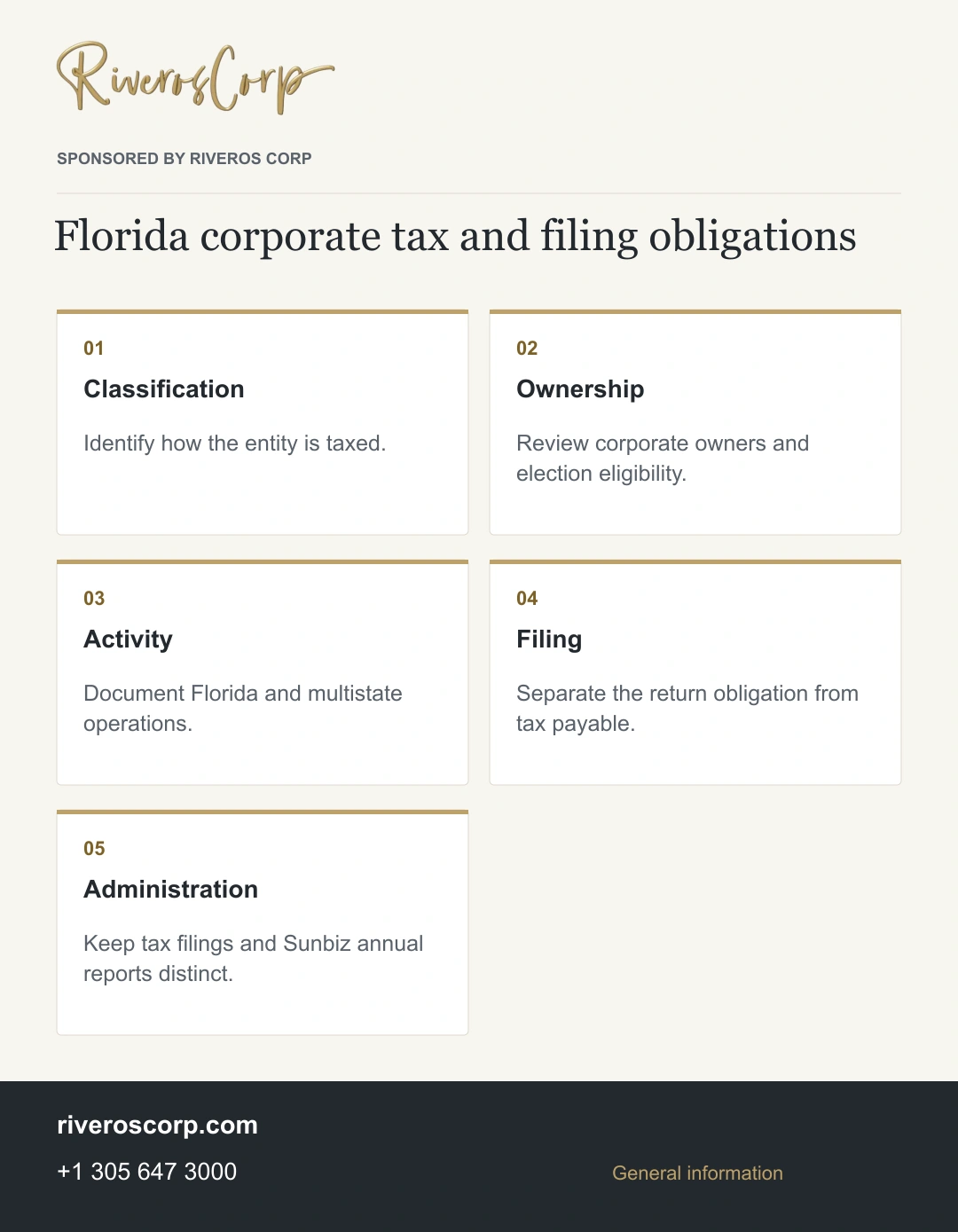
Start with the entity’s legal structure, tax classification, ownership and activities. Those facts help determine whether the business must file its own return or whether income is reported through a corporate owner. The Division of Corporations annual report updates the entity’s state registry information. A required income tax return goes separately to the Florida Department of Revenue.
Florida corporate income tax concerns the business entity
Florida imposes its corporate income and franchise tax on corporations for conducting business, deriving income or existing within the state. The framework includes entities treated federally as corporations. State incorporation is therefore only one fact in the analysis.
A corporation formed elsewhere may still have Florida obligations because of its activities or income. Conversely, an entity’s name alone does not establish how it is treated for tax purposes. Records of formation, elections and operations need to be reviewed together.
Our explanation of corporations versus LLCs describes the structural distinction. For tax purposes, a professional should connect that structure to the applicable federal and state classification. Choosing an entity label without reviewing its actual tax treatment can leave an owner with an incomplete picture of annual obligations.
A C corporation files as a separate taxpayer
A C corporation is generally a separate federal income tax taxpayer. Florida’s corporate tax framework uses federal taxable income as a starting point, with state modifications and other rules. A federal return therefore supplies important information, but it does not replace the Florida analysis or filing.
The owner’s personal residency is a different issue. A shareholder who lives outside Florida, or outside the United States, should not assume that the corporation’s Florida obligations disappear. The business’s organization, activities and tax classification remain relevant.
Similarly, a corporation that distributes no dividends can still have corporate income tax responsibilities. Whether the shareholder receives a distribution and whether the corporation must file are separate questions. The annual review should address the company first and then evaluate the owner’s tax consequences under the applicable rules.
LLC treatment depends on classification
An LLC classified as a corporation for federal and Florida income tax purposes is subject to the Florida Income Tax Code and must file the applicable corporate return. An S election, if valid, requires the additional review described below. The letters LLC in the company name do not establish an exemption.
A single-member LLC disregarded for federal and Florida income tax purposes does not file a separate Florida corporate income tax return. When a corporation owns it, directly or indirectly, the corporate owner includes the LLC’s income in its Florida return. The Department of Revenue states that this applies even when owning the LLC is the corporation’s only activity.
An LLC classified as a partnership must file the Florida Partnership Information Return, Form F-1065, if one or more owners is a corporation. That corporate owner must also file its corporate income and franchise tax return. An ownership chart should therefore show the entities above the LLC as well as its immediate members; stopping at the first company name may leave the corporate owner unidentified.
S corporation treatment has exceptions
Many S corporations do not owe Florida corporate income tax in the same way as ordinary C corporations, but the state identifies circumstances in which an S corporation has a filing obligation because it pays specified federal income tax. A blanket statement that every S corporation is outside the system is therefore inaccurate.
The first question is whether a valid S election exists and remains effective. A state corporation filing does not make that federal election. Eligibility restrictions also matter, including the prohibition on nonresident alien shareholders. Foreign citizenship alone is not the same as nonresident alien tax status.
Our discussion of articles of incorporation for C and S corporations explains why the organizational document and tax election should be distinguished. A qualified tax professional should review election records, shareholder eligibility and any corporate-level federal tax before deciding what Florida requires for the year.
Tax-exempt organizations and associations have specific rules
An organization exempt from federal income tax can still have unrelated trade or business income for federal tax purposes. Florida subjects that income to its corporate income tax and requires the appropriate return. The federal exemption letter does not resolve the treatment of every later revenue-producing activity.
Review the activity producing the receipts, the expenses connected with it and the federal treatment. An organization might receive donations, charge for activities connected with its exempt purpose and conduct other business in the same year. Those receipts should remain distinguishable in the records so the tax preparer can identify which rules apply.
Homeowner and condominium associations have another specific distinction. Those filing federal Form 1120 must file Florida F-1120 or, if eligible, F-1120A, even if no tax is due. Associations filing federal Form 1120-H are not required to file the Florida corporate return on that basis. The federal form actually used matters more than the informal label “nonprofit association.”
Federal income is adjusted under Florida rules
Florida begins with federal taxable income and applies state additions, subtractions and adjustments. When a corporation operates in more than one jurisdiction, allocation and apportionment rules may affect the portion associated with Florida.
The Department of Revenue describes a general apportionment approach involving property, payroll and sales, subject to the applicable rules. A business should not assume that the address on its formation document assigns all income to Florida or that an out-of-state mailing address removes all Florida income.
Keep records showing where the company operates and earns its receipts. A tax professional may need details beyond a profit and loss statement, particularly for multistate operations. For a multistate business, keep location records with the accounting records used to assign receipts.
A filing requirement can exist even when no tax is due
Florida’s guidance states that corporations required to file the corporate income and franchise tax return must file annually even when no tax is due. A zero tax calculation does not remove a return requirement.
The same distinction matters when a company has losses, has only recently started or has limited activity. The preparer should establish whether the entity is required to file, then determine the tax result. Reversing that order can cause the company to miss a filing obligation because it assumes there will be no payment.
Keep the completed return and submission confirmation, even for a year with no payment. If the company’s filing status changes, review the Department of Revenue’s account update procedures. Simply stopping returns without addressing the account can leave unresolved correspondence or inconsistent state records.
Florida Form F-1120 is separate from federal Form 1120
The similar names can be misleading. Federal Form 1120 and Florida Form F-1120 serve different jurisdictions and reporting requirements. A provider’s statement that it prepared “the corporate return” should specify which return is included.
The Division of Corporations annual report is another separate filing. It updates and maintains the entity’s state registration information; it is not a substitute for the corporate income tax return. A business can be current on its annual report while still having unresolved tax obligations.
Owners should ask for a clear annual filing list that identifies the responsible provider and the evidence of completion for each task. Our guide to Florida articles of incorporation describes the initial organizational record, which should be kept alongside later annual reports and tax records without treating them as interchangeable documents.
Florida extensions and payment requirements
Florida uses Form F-7004 for its tentative return and request for an extension to file. The request and any required tentative payment are due by the original Florida return deadline. Filing a federal extension alone does not satisfy that state procedure.
The extension generally allows six additional months, with a seven-month extension for a June 30 tax year end. It does not extend the date for paying the tax. The required tentative payment reflects the annual tax after estimated payments and applicable credits; an underpayment can affect the extension and create additional charges.
For a company with incomplete books, the preparer still needs to assess the filing and payment positions before the deadline. Identify the year-end, previous payments and any prior-year credit. Keep the submitted state extension and payment evidence with the eventual return rather than relying on a verbal statement that the company has an extension.
Other business filings remain separate
A business can have sales and use tax, employment-related taxes, federal information reporting or local obligations even when it owes no Florida corporate income tax. Each obligation has its own trigger. A domestic disregarded LLC owned by a foreign person, for example, may need a federal related-party reporting review without filing a separate Florida corporate return.
Riveros Corp’s overview of Florida taxation provides context for owners comparing locations. Use the company’s actual classification and activities to determine its obligations, including the exceptions explained here. The absence of individual state income tax is one feature of the system, not a finding that every business filing is unnecessary.
For the organizational side, Riveros Corp offers business document and maintenance services, including EIN records and annual reports. The tax professional handling the company’s returns should determine its Florida tax filings. Keep a separate completion record for the annual report, federal return, state return and any extension that applies.
Frequently asked questions
Does every Florida LLC pay corporate income tax?
No. Treatment depends on the LLC’s tax classification and ownership. An LLC taxed as a corporation is treated differently from a disregarded LLC or a partnership-classified LLC. Corporate ownership can also create reporting consequences. A professional should review the structure rather than deciding from the LLC designation alone.
Does Florida’s lack of personal income tax exempt my corporation?
No. Personal income tax and corporate income tax are separate matters. A corporation may have Florida return and payment obligations even when its individual shareholder has no Florida personal income tax return. Federal obligations and other business taxes also need separate consideration.
Must a company file if its Florida tax calculation is zero?
A corporation required to file must submit the return even when no tax is due. The filing obligation should be determined separately from the payment result. Keep evidence of the filed return so the company can show what was reported if the state later sends an inquiry.
Is the Sunbiz annual report the same as a tax return?
No. The annual report maintains entity information with the Division of Corporations. Florida Form F-1120 is a corporate income and franchise tax return administered by the Department of Revenue. Completing one does not establish that the other has been completed or is unnecessary.
Does an out-of-state corporation avoid Florida corporate tax?
Not automatically. Florida activity, income and other relevant connections can create obligations for an entity formed elsewhere. The review may also involve apportionment and ownership relationships. The formation state and mailing address are useful facts, but they do not alone resolve the tax analysis.
Organize your Florida business records
Contact Riveros Corp at +1 305 647 3000 or through WhatsApp for company records, EIN documentation and annual report assistance. Provide the legal entity name and the records already available. Coordinate the corporate tax return and any extension with the tax professional responsible for those filings.
By Zulma E Bourelly. General information only. Individual legal and tax questions require advice from an appropriately qualified professional.