Nonprofit bylaws explain how an organization makes decisions. They identify the people who can act, how those people are selected and what happens when leadership changes. They should make clear who may approve a contract or replace a director.
The IRS may examine bylaws when reviewing an exemption application, and state law can require them. Those two points do not mean the IRS supplies a universal governance template. An organization’s legal form, activities and governing law still matter.
For a Florida nonprofit, the review should also use current law. Chapter 617 changed in July 2026, including provisions affecting board structure. For an existing organization, that means checking the current board provisions against the adopted bylaws. For a new charity, it means establishing the intended structure before leaders begin making decisions under it. Someone reading the adopted rules should be able to identify who has authority now. Meeting notices, voting requirements and amendment procedures should fit the organization’s actual leadership and membership.
What nonprofit bylaws actually govern
Bylaws usually address directors, officers, meetings, voting and amendments. They provide continuity when a founder leaves or the board changes. A new director should be able to understand the decision process without relying entirely on someone else’s memory.
They also distinguish board authority from day-to-day duties. For example, an officer may handle routine operations while certain commitments require board approval. The document should describe the arrangement accurately, without assigning powers that conflict with the articles or governing law.
Membership needs particular care. A charity may call donors or volunteers “members” in everyday conversation without intending them to hold legal voting rights. Whether the corporation has statutory members, and what those members can approve, should be deliberate rather than accidental.
Under Florida section 617.0206, the board adopts the initial bylaws unless the articles reserve that power to the members. The board also holds amendment authority unless the articles or bylaws provide otherwise. That is the starting rule for identifying who can adopt a draft; the founder or document preparer does not acquire that power merely by writing it.
Bylaws and articles serve different purposes
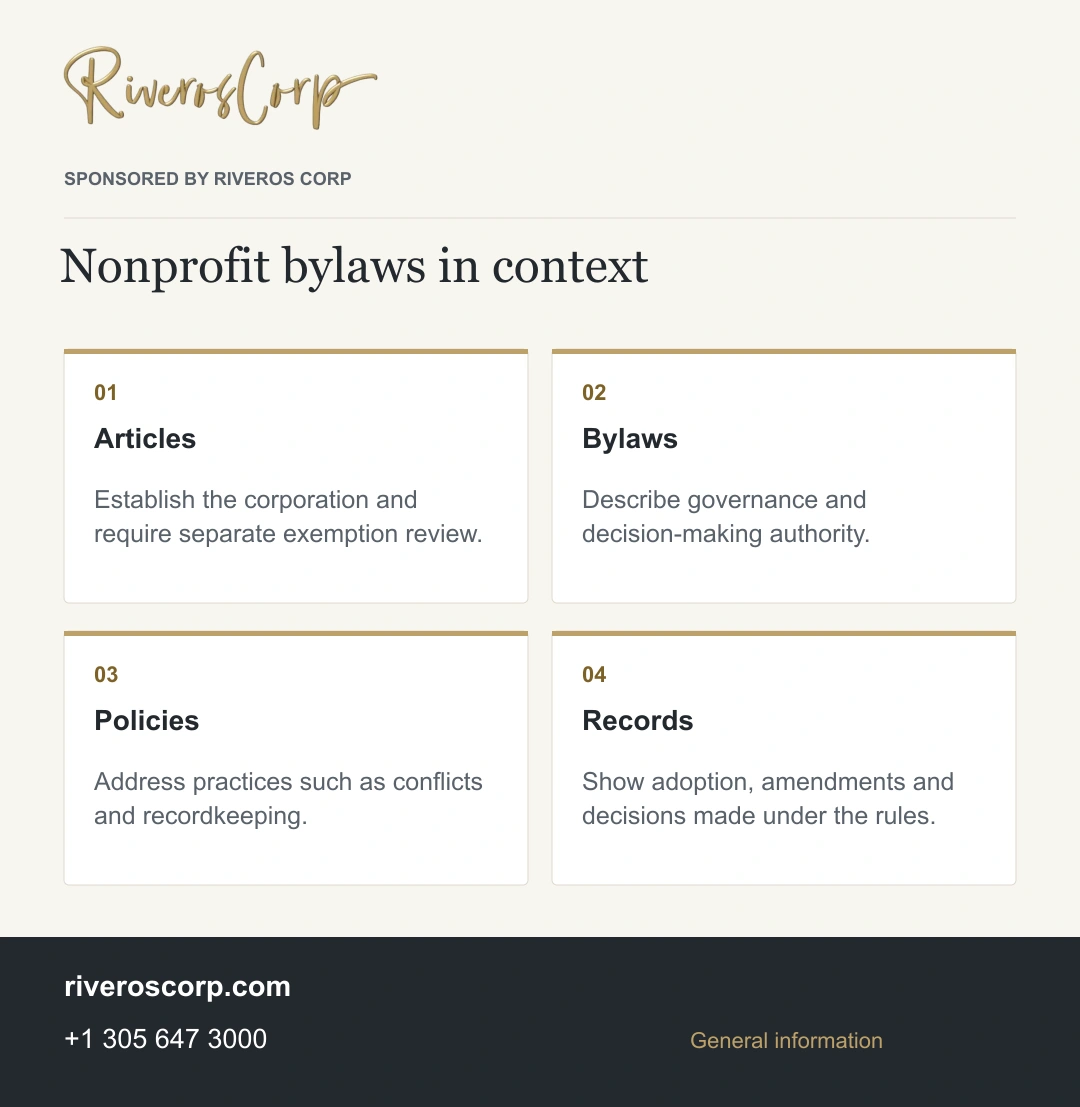
Articles of incorporation establish the nonprofit corporation through a state filing. Bylaws normally explain internal governance. Their subjects can overlap, but placing a provision in one document does not always satisfy a requirement that applies to the other.
For federal exemption, the organizational test examines the organizing document’s purposes and dedication of assets. A corporation should not assume that adding charitable language only to its bylaws fixes deficient articles. The documents need to be reviewed together, including any applicable state-law provisions.
A dissolution provision requires similar attention. Charitable assets cannot become a founder’s personal property simply because the organization closes. The governing framework must address the required disposition of remaining assets, and conflicting provisions need correction in the proper document.
Our discussion of nonprofit articles of incorporation explains the formation document. For the relationship between the two records, see articles of incorporation versus bylaws. That distinction is especially useful when a board receives a request for “corporate documents” without a precise list.
Sections worth discussing before drafting
Begin the review with the corporation’s identity, purpose and governance model. Then address director selection, terms, vacancies and removal. Those provisions should work together: an appointment rule is incomplete if nobody knows how an unexpected vacancy is filled.
Meeting provisions should address how decisions are called, discussed and approved under applicable law. Notice, quorum and voting rules matter because a group can agree informally while still failing to document a valid corporate action. Remote participation also deserves review if directors live in different places.
Officer responsibilities should match the way the organization operates. Financial oversight, recordkeeping and authority to sign deserve clear treatment. Avoid giving several roles overlapping powers without explaining how conflicts or limits are resolved.
An amendment provision should identify who can change the bylaws and the approval needed. Read it alongside the articles, which may reserve powers to members. For example, changing a board’s composition can affect how later decisions are approved. Establish the authorized amendment process before circulating a revised document as though it is already in force.
Board structure under current Florida law
Florida revised its nonprofit corporation law effective July 1, 2026. Under the current section 617.0803, the general rule permits a board of one or more individuals, as specified in or under the articles or bylaws. A corporation exempt under section 501(c)(3), however, must have at least three directors.
That distinction matters when someone repeats the older statement that every Florida nonprofit must always have three directors. A formation project intended to obtain charitable exemption should address the exempt-organization requirement from the outset, rather than treating the general minimum as the whole answer.
Directors also need access to the records behind a decision. A board considering a contract should know its terms and who has an interest in it. Naming three people satisfies the numerical point only; it does not establish that a meeting had a quorum, that required disclosures occurred or that the directors approved the proposed transaction.
Family relationships and business connections also need review. They do not automatically answer every eligibility question, but they can affect independence and conflict management. Explain those relationships accurately when asking for professional guidance about the proposed structure.
Conflict policies and IRS governance questions
Federal tax law generally does not prescribe a particular management structure or every governance policy. The IRS nevertheless asks about governance because decisions involving charitable assets can affect compliance. Its interest does not make every recommended practice a standalone statutory condition of exemption.
A conflict-of-interest policy can help identify a director’s financial interest before the organization enters a transaction. It should explain disclosure and the process for addressing that interest. The organization also needs to follow the policy and preserve an accurate record of what happened.
Consider a director whose business offers to supply services. A policy’s presence in a binder does not resolve whether the proposed arrangement is appropriate. The relevant people must evaluate the facts, follow applicable approval rules and obtain advice when needed.
A conflict policy may sit in a separate document, with its own adoption record and revision date. The bylaws and policy should give consistent instructions about who handles a disclosed interest. When an IRS filing asks whether a policy exists or was followed, the answer needs to match the adopted version and actual practice during the reporting period.
Why the IRS may read nonprofit bylaws
The full Form 1023 application calls for bylaws or other rules of operation, including amendments, if adopted. The IRS can compare them with the formation documents and the description of activities. Inconsistent names, purposes or authority provisions can prompt questions.
The IRS also compares the governing documents with what the organization does. A document describing broad public service does not resolve activities that principally benefit insiders. Similarly, a detailed board structure does not establish that the people identified actually make the organization’s decisions.
Organizations that file Form 990 encounter governance questions as part of ongoing reporting. The appropriate response depends on actual practices during the relevant period. Copying last year’s answers without checking changes can create an inaccurate account of how the organization operates.
Before submitting adopted bylaws, compare the version with the amendment records and the organization’s actual structure. The IRS instructions request the current text and amendments; they do not generally require bylaws to be signed unless the bylaws are themselves the organizing document. An unsigned copy and an unadopted draft are therefore different problems and should not be treated as equivalent.
Are nonprofit bylaws public?
Bylaws are generally internal corporate records rather than the formation articles filed with the state. That does not make them confidential in every setting. Disclosure duties depend on how the document is used and on the laws governing the organization.
When bylaws are submitted as part of an approved federal exemption application, they can become part of the application materials subject to public inspection. A nonprofit should not promise that everything sent to the IRS will remain private.
Separate rights to inspect corporate records may exist for members or other authorized parties under state law. Grant applications, bank reviews and contractual arrangements may also require copies. Each request should be assessed on its own basis rather than answered with a blanket rule.
Keep unnecessary personal and financial identifiers out of governance documents and application attachments. Privacy review should preserve legally required information while avoiding unrelated sensitive material. It should not become a reason to conceal material facts or provide an incomplete required record.
Church and ministry bylaws need careful tailoring
A church may organize leadership through a congregation, elders, trustees or a denominational structure. Its civil documents should reflect the applicable arrangement accurately. Borrowing another church’s rules can accidentally assign authority to a body that does not exist in the new organization.
Spiritual responsibilities and corporate authority can interact, but they are not interchangeable labels. The bylaws should help identify who handles property, contracts and corporate decisions while respecting the organization’s religious governance. Difficult questions about that relationship belong with qualified counsel.
Also distinguish a church from another religious ministry. A religious purpose does not automatically establish church classification for federal tax purposes. The entity’s activities and circumstances matter, and a document title cannot settle that analysis by itself.
Leadership transitions deserve attention before a dispute arises. The governing documents should address the relevant appointment, succession and amendment arrangements. Avoid drafting around an assumed permanent founder without considering how the organization will continue if that person can no longer serve.
When amendments and document reviews are useful
A leadership change, new membership structure or substantial program change may expose provisions that no longer fit. Review the existing document before editing it. The people authorized to approve an amendment, and the procedure they must follow, may differ from those handling everyday operations.
Preserve the approved amendment and its adoption record. If the organization prepares a consolidated version, make sure it incorporates the changes accurately. Multiple files labeled “final” can lead a bank, grantmaker or director to rely on an obsolete version.
When an adoption record is missing, gather the minutes, notices and correspondence that remain. Those materials may show what was approved, or they may leave an issue unresolved. A later correction should record its own date and basis. Keeping that history allows future directors to distinguish the rules in force at an earlier meeting from changes adopted afterward.
Riveros Corp provides document preparation for churches and ministries, including standard bylaws, policies and meeting records completed with the organization’s actual information. Bring the articles, current bylaws and amendments. Questions about governance design or exemption qualification need the appropriate legal or tax adviser before the resulting decisions are put into the records.
Frequently asked questions
Do nonprofits need bylaws?
State law and legal form matter. Florida law provides for nonprofit corporate bylaws. Federal tax law does not generally require particular bylaw language for most organizations, but the IRS may request adopted bylaws and examine how the organization is governed.
What should nonprofit bylaws include?
Common subjects include directors, officers, legal membership, meetings, voting, vacancies and amendments. The provisions must fit the organization and applicable law. Required formation and exemption provisions also need review in the organizing document; bylaws alone may not satisfy those requirements.
Are nonprofit bylaws available to the public?
Sometimes. They can become publicly inspectable when included with an approved exemption application. State inspection rights and other disclosure duties may also apply. Their usual status as internal corporate records is not a promise of confidentiality.
What is the 33% rule for nonprofits?
The phrase often refers imprecisely to a one-third public-support test used for certain public-charity classifications. It is not a universal bylaw rule, board-composition requirement or spending formula. Different classifications use different tests, and some charities qualify without that particular support calculation.
Does a bylaw template guarantee 501(c)(3) approval?
No. Exemption depends on the organizing documents, purposes, activities and applicable federal requirements. A template can overlook state-law provisions or contradict the actual governance arrangement. It should not be treated as an IRS approval or a complete legal review.
Discuss your nonprofit records
Contact Riveros Corp at +1 305 647 3000 to discuss organizing your nonprofit documents. Bring the current articles, bylaws and amendment records so the requested work can be identified accurately.
General information, not legal or tax advice for a particular situation. By Zulma E Bourelly.