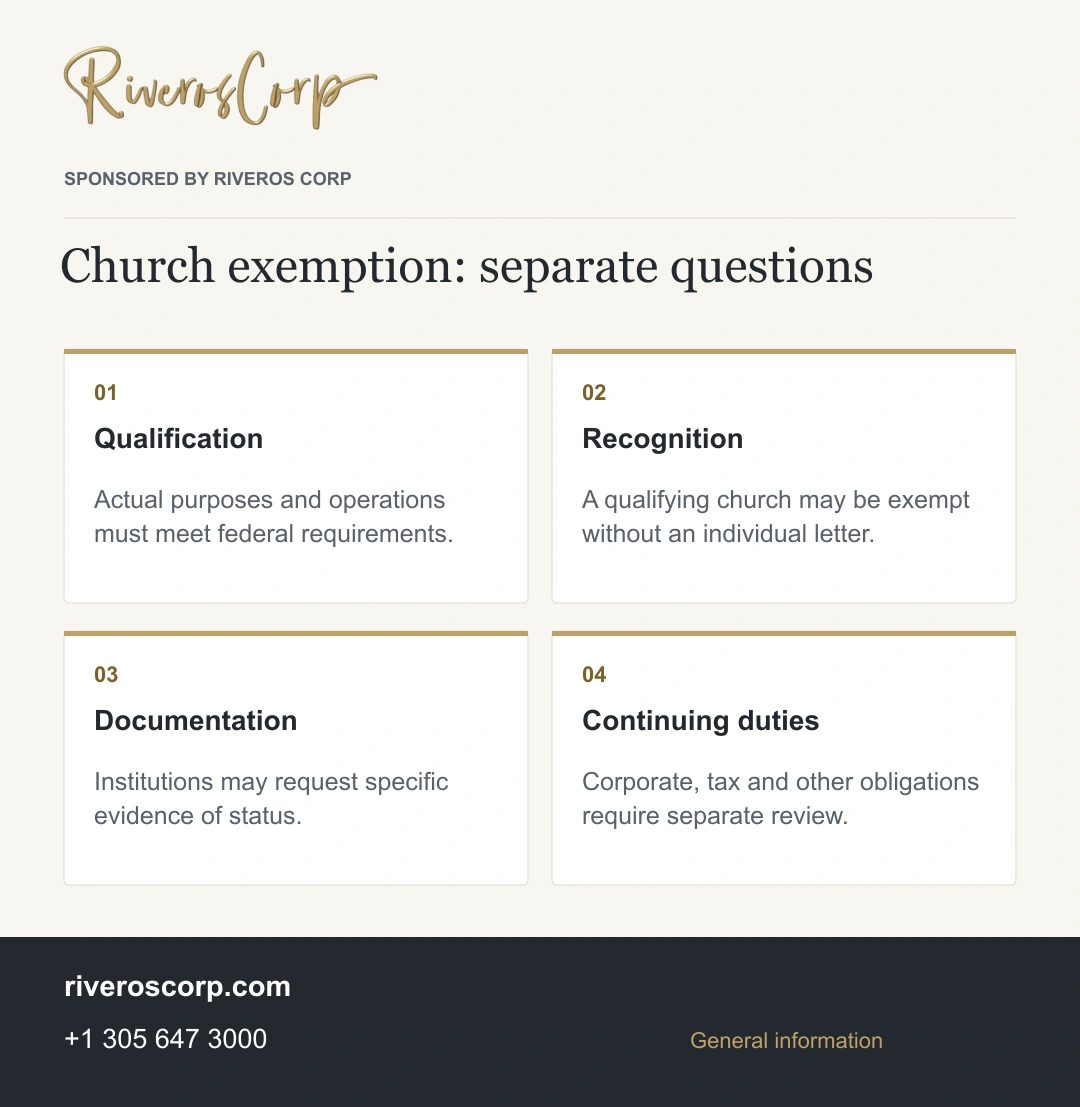
Are churches 501c3 automatically? A church that meets the requirements of section 501(c)(3) is generally considered tax exempt without applying for an IRS determination letter. The qualification matters: adopting the word “church” in a name does not establish compliance by itself. Its purposes, activities and organization must support the claimed status.
Confusion often arises when a bank, donor or other institution asks for proof. A qualifying church can be exempt without an individual IRS letter, while the institution may still request documentation for its own review. The church’s available records might include its organizing documents, a determination letter or evidence of coverage under a denomination’s group exemption.
Each record answers a different question. State incorporation establishes a corporate entity; federal exemption concerns tax treatment; an IRS letter documents recognition. Church leaders also need to distinguish an exception from annual Form 990 reporting from other duties, such as employment taxes or state corporate filings. Understanding those distinctions helps the congregation explain its status accurately and keep the records that future leaders will need.
Are churches 501c3 without an application?
The IRS states that churches meeting section 501(c)(3)’s requirements do not have to apply for recognition of exemption. The rule also covers qualifying integrated auxiliaries and conventions or associations of churches. These categories have their own requirements; affiliation in ordinary conversation is not enough.
The exception concerns the recognition application. It does not remove the underlying standards for exempt purposes and operations. A church must still be organized and operated consistently with the applicable federal requirements, including restrictions on private inurement.
A determination letter is therefore evidence of IRS recognition, not the only possible basis for a church’s exemption. When discussing status, explain whether the church has an individual letter, relies on a qualifying group arrangement or has not applied for recognition.
Avoid telling donors that a newly registered name automatically makes every payment deductible. The organization’s qualification and the donor’s contribution rules both matter. Accuracy is especially important when public materials describe a ministry as “IRS approved” even though it has never received a determination.
What the IRS means by a church
The Internal Revenue Code uses the term church without supplying a single comprehensive definition. The IRS evaluates characteristics together with other facts and circumstances. Relevant considerations include a recognized form of worship, religious governance, a regular congregation and regular religious services.
The analysis is not a mechanical scorecard requiring every characteristic in every case. Different faith traditions organize worship and leadership differently. The question is whether the facts support church classification under the applicable standards, not whether the organization copied a preferred description.
A religious publisher, outreach project or educational ministry may have an exempt religious purpose without qualifying as a church. That distinction can affect application and annual-return requirements. It should be assessed before relying on exceptions that apply specifically to churches.
A description of the ministry should explain how and when people gather, how leaders are selected and what the organization provides. Worship schedules and governing documents can help establish those facts. If the ministry’s activities have changed, identify when the change occurred; a description written at formation may no longer explain its current operation.
Nonprofit incorporation is a separate legal step
A state nonprofit corporation is a legal entity. Federal 501(c)(3) status concerns its treatment under federal tax law. A state filing can establish the corporation without establishing that its purposes and activities satisfy the federal exemption requirements.
Formation articles also serve a different role from bylaws. Articles establish the corporation and contain provisions relevant to the federal organizational test. Bylaws describe internal governance. Both should reflect the intended religious organization and be reviewed for consistency with applicable law.
For background, read our articles on nonprofit articles of incorporation and 501(c)(3) articles of incorporation requirements. They explain why a state-accepted filing and a document prepared for federal exemption review are not necessarily interchangeable.
For a congregation that chooses corporate form, the articles and governance record should identify the organization that holds property, enters contracts and conducts the ministry’s work. Check the name on those records against the bank and tax records. A building’s familiar name or a denominational affiliation may differ from the legal name of the local entity.
When a determination letter can be useful
A church may seek formal IRS recognition even when no application is required. The letter can help explain its status to contributors and institutions. It can also provide an identifiable record for future leaders who did not participate in the church’s formation.
Some third parties have documentation requirements that go beyond asking whether federal law requires a church to apply. A grantmaker or bank may request particular records. Clarify the actual request before assuming a legal exception will satisfy that institution’s review.
The choice to apply should account for the organization’s circumstances and intended activities. A church seeking an individual determination uses the full Form 1023 rather than Form 1023-EZ. The streamlined form excludes churches, even small congregations with limited resources.
A letter should be preserved with the application, amendments and later IRS correspondence. Future leaders need to know which entity received recognition and whether any later document changed that record. A bank or grantmaker may still request current governance or financial information; the IRS letter answers the exemption question addressed in it, not every question about the organization’s present affairs.
Donations and public searches need careful interpretation
Contributions to a church that qualifies under section 501(c)(3) may be deductible even if the church has not obtained an individual determination letter. The donor must still meet applicable rules concerning the contribution, records and deduction claimed.
An organization’s eligibility to receive deductible contributions does not mean every payment to it is a charitable gift. Purchases, benefits received and payments intended for particular individuals can raise different issues. Church receipts should describe what actually occurred rather than promise a particular tax result.
Some qualifying churches do not appear separately in the IRS public search data because they have not obtained individual recognition or are covered by a group arrangement. Absence from a search result is therefore not, by itself, conclusive proof that a church is ineligible.
When status is uncertain, collect the available documents and obtain appropriate tax advice. An unfamiliar name, an old address or a related entity’s record can also confuse a search. The review should identify the correct legal organization before drawing conclusions.
Churches retain recordkeeping and tax responsibilities
Churches and certain church-affiliated organizations are generally excepted from the annual Form 990-series return or notice requirement. This exception should not be extended to every organization with a religious purpose. Classification determines whether the exception applies.
Other filings can still be required. Unrelated business income and employment arrangements may create tax and reporting obligations. The church’s federal exemption does not mean every commercial activity or payment to a worker receives the same treatment.
Clergy compensation has its own tax rules. A minister may be an employee for income-tax purposes while ministerial earnings are generally subject to self-employment tax for Social Security and Medicare, subject to applicable exceptions. That distinction requires a separate payroll and tax review. The church’s exemption alone does not determine how payments to its workers are reported.
Maintain financial records, donation records and accurate governance decisions even where a Form 990 filing exception applies. Those records support responsible stewardship and help a qualified adviser evaluate questions. An annual-return exception is not permission to operate without an accounting record.
Private benefit and political activity require attention
Charitable resources must serve the organization’s exempt purposes rather than operate as a founder’s personal fund. Reasonable compensation for actual services can be permitted, but transactions involving leaders or related parties need careful consideration and accurate records.
Section 501(c)(3) restricts substantial lobbying and prohibits organizational intervention for or against candidates for public office. Nonpartisan voter education can be permissible, while biased campaign activity can violate the restriction. Applying the law to certain communications within houses of worship has also been the subject of litigation and a government guidance initiative.
On April 3, 2026, Treasury and the IRS announced plans for guidance on internal faith-related communications through a house of worship’s customary religious channels. The announcement described the government’s proposed litigation position. It also said the court had dismissed that case for lack of jurisdiction before considering or approving the proposed resolution. The announcement was not a repeal of the statutory restriction.
That distinction matters when planning an event or communication involving a candidate. The audience, setting, content and use of church resources need to be assessed under the guidance applicable at that time. An internal religious communication and a donation from church funds to a campaign raise different issues. Review the proposed activity with counsel before committing the organization.
State obligations do not disappear with federal exemption
State corporate compliance, charitable solicitation rules and state tax exemptions are separate subjects. A church should determine which requirements and exceptions apply in the places where it operates. A federal letter should not be treated as approval from every state agency.
In Florida, a nonprofit corporation still has annual-report duties. State sales-tax exemption involves a separate certificate, and exempt purchases must meet Florida’s conditions. Charitable solicitation has its own religious exclusion. The records are not interchangeable: a corporation’s active state record, an IRS letter and a sales-tax certificate cannot substitute for one another.
Governance documents also need to remain usable as the congregation changes. Leadership succession, authority over property and amendment procedures can become urgent during a transition. Review those provisions while decisions can be discussed carefully, rather than waiting for conflicting claims of authority.
Keep the current formation record, bylaws, amendments and IRS correspondence together. Make sure authorized leaders can identify the operative versions. Plan for continuity: the congregation should not lose access to its records when one person leaves.
Religious-worker plans require a separate immigration review
A ministry planning to sponsor a religious worker should raise that objective early with a qualified immigration attorney. Federal tax exemption and immigration eligibility are different determinations. Establishing one does not automatically establish the other.
For R-1 religious-worker classification, the organizational evidence includes a currently valid IRS determination letter confirming tax-exempt status. Other evidence addresses the organization’s religious character and relationship to the denomination. A church’s federal exception from applying for recognition does not remove the immigration program’s documentary requirements. Identify those requirements before relying on automatic church exemption as the only evidence.
The worker, position and petition also have their own requirements. A determination letter does not authorize someone to work, establish a visa category or guarantee a petition decision. Document preparation should follow a properly assessed immigration strategy.
Riveros Corp offers church nonprofit formation and document preparation, including formation paperwork, registered-agent arrangements and an EIN. Its administrative work should follow the organization and records actually needed. Questions about church classification or worker sponsorship belong with the legal or tax professional handling that issue; a corporate filing does not decide them.
Frequently asked questions
Does every organization called a church qualify automatically?
No. The exception applies to churches that meet section 501(c)(3)’s requirements. Names, websites and state incorporation alone do not establish that result. The organization’s structure, activities and relevant church characteristics must support the classification.
Is a church without an IRS letter necessarily taxable?
No. A qualifying church can be exempt without applying for recognition. However, the absence of a letter does not establish qualification either. Review the actual facts and available records before making claims about a particular organization’s status.
Are churches charitable organizations for donation purposes?
A church meeting section 501(c)(3)’s requirements can receive deductible charitable contributions. Whether a donor may claim a particular deduction depends on the gift and applicable tax rules. The church should provide accurate documentation without guaranteeing the donor’s result.
Do churches need to file Form 990?
Churches and certain qualifying church-affiliated organizations are generally excepted from the annual Form 990-series return or notice requirement. Other religious nonprofits may have to file. Separate employment or unrelated-business-income filings can still apply even when the annual information-return exception does.
Does a determination letter approve religious-worker sponsorship?
No. It may be relevant evidence of the organization’s status, but immigration eligibility requires a separate review of the petitioner, worker and proposed role. A qualified immigration attorney should assess the applicable evidence and legal requirements before a petition is prepared.
Discuss church document preparation
Contact Riveros Corp at +1 305 647 3000 to discuss the records needed for your church or ministry. Have the formation documents, current governance records and any IRS correspondence available to clarify the request.
General information, not legal or tax advice for a particular situation. By Zulma E Bourelly.