Understanding how to start a nonprofit in Florida begins with separating several decisions. State incorporation creates a legal entity. Federal recognition addresses tax exemption. Fundraising registration and state tax matters involve additional rules. Completing one does not automatically complete the others, and some obligations can arise while an IRS application is still pending.
Early choices affect later documents. A purpose statement should describe the planned work clearly enough to support an exemption review. The governance arrangement should identify who can approve that application and make other decisions for the corporation. Founders also need to distinguish their roles as directors, employees or donors from ownership of a private business.
For a Florida corporation planning charitable activities, start with an activity description, a proposed budget and a clear account of how leaders will be selected. A congregation, a grantmaking foundation and an educational program may share a state corporate form while raising different federal questions. Their actual plans determine which documents, applications and operating requirements need attention.
How to start a nonprofit in Florida with a clear purpose
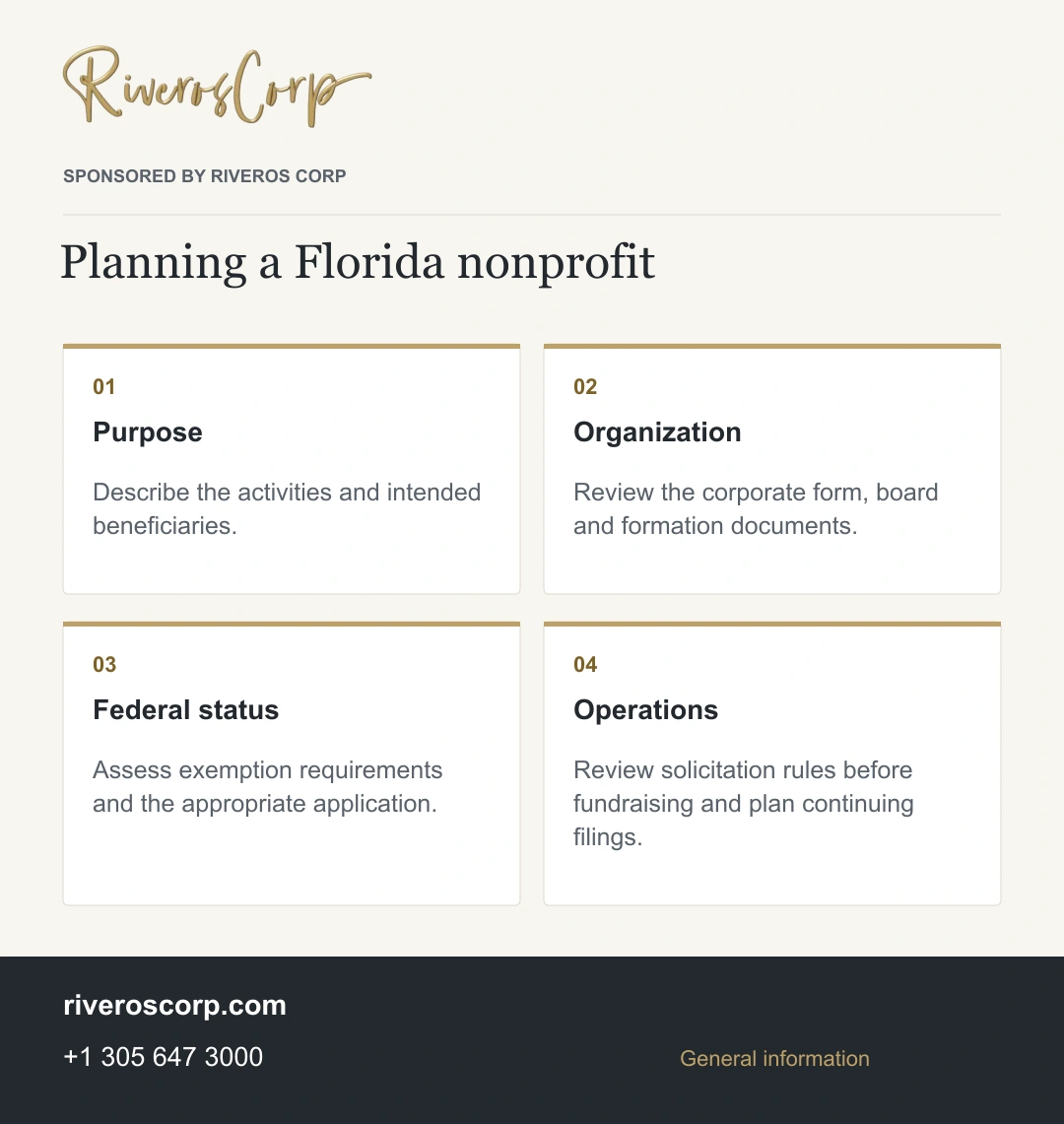
Begin by describing the work the organization will perform and the people or purposes it will serve. “Helping the community” may express a worthwhile intention, but it leaves unanswered how the organization will operate. A clearer description supports both planning and legal review.
Distinguish an intended public or charitable purpose from a project primarily benefiting designated private individuals. Federal charitable exemption involves substantive requirements. A nonprofit label does not turn a private business or personal fundraising arrangement into an eligible charity.
Consider how programs will be supported and who will oversee them. A proposed budget and a realistic activity description help identify the appropriate application route. They should reflect expected operations, not assumptions chosen to obtain a preferred classification.
The founders should also understand that a charitable corporation’s assets do not become their personal property. Compensation for actual services may be permissible under applicable rules, but ownership-style distributions are a different matter. Discuss those expectations before choosing the nonprofit structure.
Decide the legal structure and governance arrangement
A Florida nonprofit corporation operates under Chapter 617. That is a state-law form, while section 501(c)(3) is a federal tax classification. Not every nonprofit corporation is a charitable organization eligible under that federal section.
The proposed board needs genuine participants who understand their role. Consider who will make decisions, who will handle records and whether legal voting members will exist. Calling supporters “members” informally should not accidentally decide the corporation’s legal membership structure.
Florida changed Chapter 617 effective July 1, 2026. The current general board rule permits one or more directors, but a corporation exempt under section 501(c)(3) must have at least three. An organization intending to obtain that exemption should plan its governance accordingly.
The minimum number is only part of the review. Relationships among directors, proposed compensation and transactions involving founders may require additional analysis. Choose a structure that can support real oversight rather than listing names solely to complete a filing.
Review the name, addresses and registered agent
Florida requires a nonprofit corporate name to include an appropriate corporate designation, such as ‘Inc.’ or ‘Corp.’ The name must meet the state’s distinguishability rules and cannot imply an unauthorized purpose or government connection. A state name filing provides public notice; it does not, by itself, establish ownership rights in the name. Check those rights before ordering signs or adopting a public brand.
The corporation’s principal office, mailing address and registered office have different functions. Keep those distinctions clear when preparing information. An address used to receive ordinary mail does not automatically meet the requirements for a registered office.
Florida nonprofit corporations generally must continuously maintain an eligible registered agent and registered office in the state. The agent accepts the appointment and receives legal process and notices within the statutory role. That appointment does not make the agent the organization’s tax adviser or decision-maker.
Establish a reliable way for authorized people to receive forwarded documents and official correspondence. If leadership moves or contact details change, the organization needs to update the appropriate records. A formation filing should begin a workable communication process, not merely supply an address once.
Prepare articles for the intended organization
The articles identify the corporation’s name and purposes, its principal and mailing addresses, the registered agent and the incorporators. Florida also requires the method of electing or appointing directors, or a statement that the bylaws supply it. Additional provisions can address internal governance. The preparer needs the actual decisions about leadership and membership before putting them into the formation record.
If the organization plans to seek section 501(c)(3) recognition, review the federal organizational test before filing. Required purpose limitations and asset-dedication provisions need attention in the organizing document. State acceptance of a filing is not an IRS determination about those provisions.
Our explanation of nonprofit articles of incorporation covers the state formation record. The separate article on 501(c)(3) articles of incorporation requirements addresses why federal exemption planning affects that document. Review both subjects together rather than treating them as unrelated tasks.
After filing, preserve the accepted record and confirm the actual effective date. A draft, a submission acknowledgment and an accepted filing are not identical evidence. Later applications should use the organization’s correct legal name and formation information.
Establish bylaws, authority and the EIN record
Bylaws explain how the nonprofit governs itself. They should address the actual board, officers and any legal members, with provisions that fit the articles and current law. An unrelated organization’s bylaws may describe a governance system that the new corporation does not have.
The initial bylaws normally require board adoption, unless the articles reserve that power to members. Keep the adoption record with the bylaws and document the appointments and authorizations that follow. A completed template alone does not show that the corporation approved it. If an approval is missing, address it using the current facts rather than inventing a past meeting.
An EIN identifies the organization for federal tax administration and is needed for an exemption application. Obtaining one does not establish 501(c)(3) status. Our article on what an EIN means explains why this identifier should be distinguished from other company documents.
Financial arrangements also need preparation. The bank will apply its own account-opening requirements, including evidence of the entity and authorized people. Keep the organization’s finances and records distinct from a founder’s personal transactions, and explain any proposed related-party arrangements to the appropriate adviser.
Choose the federal exemption route after review
An organization seeking recognition under section 501(c)(3) generally considers Form 1023 or, if eligible, Form 1023-EZ. The streamlined route has a required eligibility worksheet addressing finances, legal form, activities and organizational history. Being newly incorporated is not enough to qualify.
The full application may be necessary because of the organization’s category or the determinations requested. Churches have a distinct recognition exception when they meet the federal requirements, but a religious label alone does not establish that exception. Assess the actual organization before choosing the route.
The application should describe intended activities accurately and consistently with existing records. Distinguish programs already operating from future plans. Explain assumptions behind financial projections rather than presenting estimates as money already received or commitments already secured.
Assign responsibility for the IRS correspondence while the application is pending. A request for more information needs an answer supported by the organization’s records, and leaders should know who can approve that response. Required annual returns or notices still need attention during the application period. Include those deadlines in the first year’s calendar before the IRS decision arrives.
Address Florida fundraising rules before soliciting
The Florida Department of Agriculture and Consumer Services administers the Solicitation of Contributions Act. Organizations soliciting contributions in or from Florida generally need registration and annual renewal unless an applicable exclusion or exemption applies. This subject should be reviewed before launching a fundraising campaign.
Federal tax exemption and fundraising compliance are separate. An IRS letter does not substitute for the relevant Florida registration. A donation button, event or fundraising arrangement should be assessed in light of the actual activities and applicable law.
FDACS identifies exclusions for bona fide religious and educational institutions, among other categories. Its separate small-charity process has conditions, including unpaid personnel and restrictions on paid fundraising arrangements. That process still requires an application and annual financial information. Small size alone is therefore not a reason to assume that the organization has nothing to file.
If fundraising will reach other states, discuss those plans as well. The Florida filing does not settle all obligations elsewhere. Keep the organization’s fundraising description, public statements and financial records consistent with what it actually does and the registrations it maintains.
Review state taxes and program requirements separately
Florida tax exemptions have their own requirements. Qualifying for exemption from one tax does not necessarily exempt the organization from every other tax. Federal recognition may be relevant evidence, but it does not eliminate the need to evaluate state treatment.
Florida’s Consumer’s Certificate of Exemption covers qualifying organizations’ eligible purchases under state rules. The organization must pay with its own funds; an individual’s purchase does not become exempt merely because the nonprofit later reimburses it. Sales by the nonprofit raise a separate question. The certificate should be used for qualifying organizational purchases, not a founder’s personal transactions.
Hiring staff, selling goods, operating a facility or conducting regulated programs can add requirements. These depend on the activity and location. Identify them before opening the program rather than assuming nonprofit incorporation supplies every authorization needed.
Build those obligations into operational planning. Someone should know which adviser handles tax questions, which person monitors licenses and where supporting records are stored. A clear division of responsibilities makes it easier to recognize when a planned change requires another review.
Plan the first year of continuing compliance
Florida nonprofit corporations have a state annual-report obligation separate from federal tax returns. Section 617.1622 places the first report between January 1 and May 1 of the year after the articles become effective, with reports annually thereafter. For a corporation formed in November 2026, that means its first regular annual-report period is in 2027.
The organization should also identify its federal return or notice requirements and any applicable exception. A state annual report does not fulfill an IRS filing requirement. Fundraising renewals and state tax matters may add other dates to the calendar.
Preserve current bylaws, approved amendments, financial records and official correspondence. Leadership changes should include a documented transfer of access to those records. Depending entirely on one founder’s personal inbox can leave the organization unable to respond when that person is unavailable.
Riveros Corp provides Florida nonprofit formation and document preparation. Its services include formation paperwork, registered-agent arrangements and preparation of an IRS application file from client-supplied information. Share the intended programs and governance decisions when defining the work. A licensed professional should resolve legal or tax questions that affect the declarations the organization will make.
Frequently asked questions
What qualifies an organization as a nonprofit?
State nonprofit status depends on its legal organization under the relevant law. Federal charitable exemption requires additional conditions concerning purposes, activities and private benefit. A helpful mission, an EIN or a state filing alone does not establish every status the organization may need.
How much funding is needed to start?
The resources depend on the programs, staffing, facilities and continuing obligations. Prepare a realistic operating plan and discuss the scope with the appropriate advisers. Formation expenses alone do not represent the resources needed to carry out and maintain the organization’s activities.
Does Florida incorporation automatically provide 501(c)(3) status?
No. State incorporation creates the entity. Federal exemption has separate requirements and generally involves an IRS recognition application unless an exception applies. Review the intended federal classification when preparing the formation documents.
What is the 33% rule for nonprofits?
It commonly refers to a one-third public-support test for certain public-charity classifications. It is not a universal Florida formation requirement or a rule about how much every nonprofit must spend. The applicable classification and financial facts determine which test matters.
Can a new nonprofit solicit donations immediately?
Review fundraising requirements before soliciting. Florida generally requires registration for solicitation in or from the state unless an exclusion or exemption applies. Federal recognition, state incorporation and fundraising registration have separate functions; one does not automatically satisfy the others.
Discuss your Florida nonprofit project
Contact Riveros Corp at +1 305 647 3000 to discuss nonprofit document preparation. Explain the planned activities, proposed leadership and fundraising plans so the administrative scope and questions needing professional review can be identified.
General information, not legal or tax advice for a particular situation. By Zulma E Bourelly.