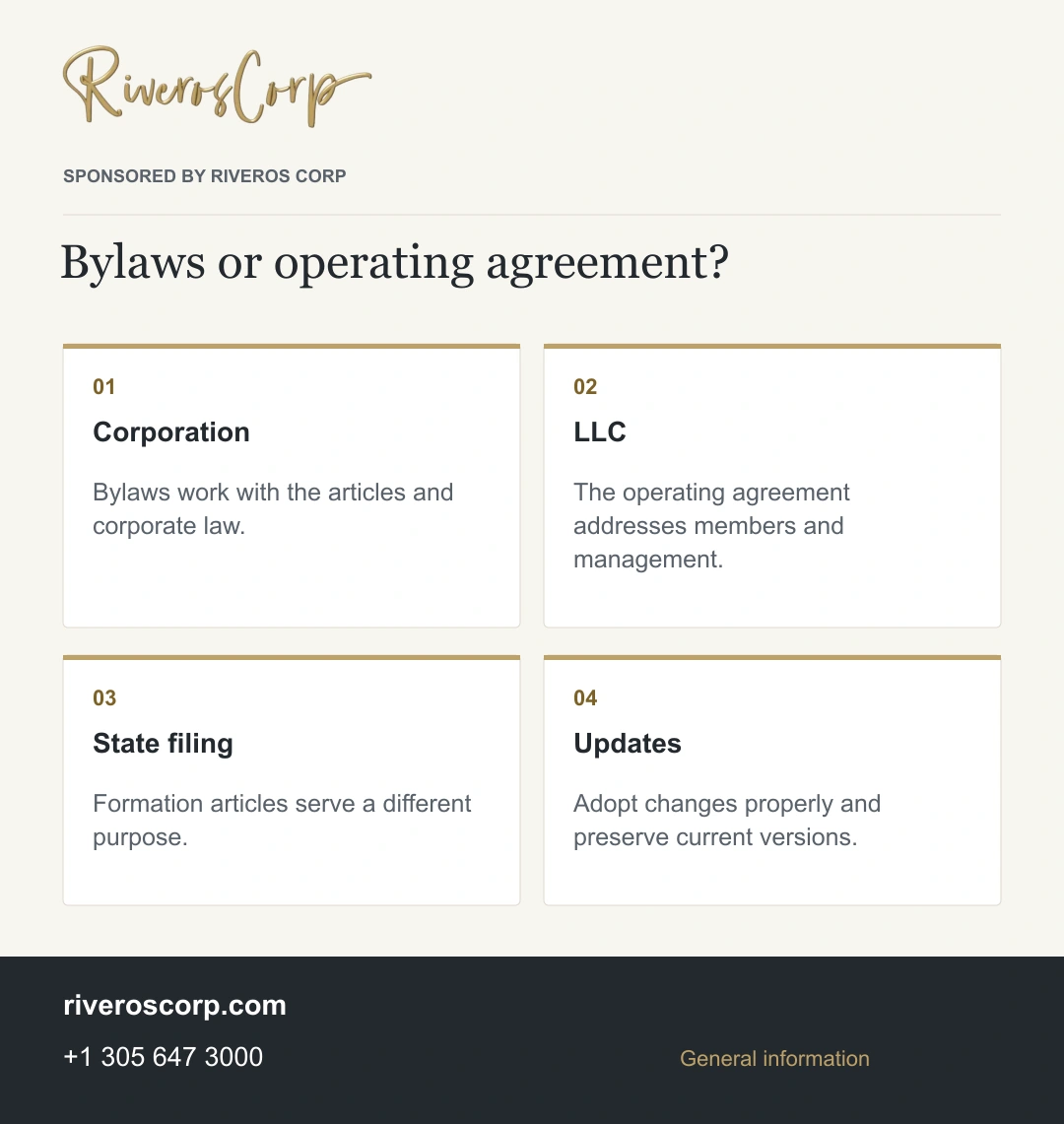
The bylaws vs operating agreement question depends on which legal entity you have. A corporation generally uses bylaws to govern its internal structure and procedures. An LLC uses an operating agreement to address member relationships, management and other company affairs. The documents serve related purposes, but they are not interchangeable.
An owner may encounter both terms when a bank asks for company records. The request should be matched to the entity that actually exists. An LLC does not become a corporation because a bank’s checklist says “corporate bylaws,” and a corporation should not simply adopt an LLC document under a different title.
Florida law supplies separate frameworks for corporations and LLCs. The articles, governing agreement and applicable statute need to be read together. Read the terms and adoption record as well as the title; those show which rules the company actually adopted. After an ownership change, an old copy may omit terms the company has since adopted.
Bylaws vs operating agreement at a glance
Corporate bylaws commonly address directors, officers, meetings, notices and voting procedures. They operate within the structure established by corporate law and the articles of incorporation. They should describe how the corporation’s decision-making bodies carry out their responsibilities.
An LLC operating agreement commonly addresses relations among members and the company, management rights and duties, the company’s affairs and amendment procedures. Florida section 605.0105 identifies those areas and provides statutory rules where the agreement does not address a matter.
Both documents can help explain who may approve an action and how that approval should be recorded. However, corporate shareholders, directors and officers are not simply different names for LLC members and managers. The entity’s legal structure determines the meaning of each role.
The law limits what each document can change. Corporate bylaws must remain consistent with the articles and the statute. For LLCs, section 605.0105 preserves rules that an operating agreement cannot override, including registered-agent requirements and the obligation of good faith and fair dealing. A provision’s legal effect therefore depends on its subject as well as the words the owners signed.
What bylaws govern in a corporation
Florida section 607.0206 requires adoption of initial corporate bylaws by the incorporators or board, unless the articles reserve that power to shareholders. The bylaws then operate as part of the company’s governance framework. A document downloaded but never properly adopted may not establish the rules the owner assumes it does.
The text can address the board’s composition and procedures, officer roles, meeting arrangements and how notices or records are handled. It should work with the actual share structure and any relevant agreements. A small company still needs its rules to fit its own situation.
The bylaws should also be used. If the company repeatedly acts in a way inconsistent with them, an owner should not assume the written rules quietly changed. A legal review may be needed to assess past actions and properly update the document for future use.
Our article on articles of incorporation versus bylaws explains the relationship between the public formation document and internal corporate rules. Keeping both current is more useful than treating one as a substitute for the other.
What an LLC operating agreement governs
An operating agreement can address how members make decisions, whether management is handled by members or designated managers, and what approvals are required for particular actions. It may also address contributions, distributions, transfers and events affecting a member’s participation.
These terms affect practical decisions. An owner preparing to sign a contract needs to know who has authority. Members considering a new investor need to know the rules for admission and transfers. A departing member needs more than an informal understanding about what happens next.
An operating agreement can set voting rules and procedures, but it cannot simply remove every duty owed by members or managers. Section 605.0105 places limits on changes to loyalty, care and access to information, among other matters. The permitted changes depend on the provision. Counsel should review a proposed departure from those rules instead of assuming that broad consent makes it effective.
The scope of the agreement should match the company’s real arrangements. Our explanation of the purpose of an LLC operating agreement discusses how the document supports management and ownership planning. A signature page alone does not show whether the operative terms address the company’s needs.
Formation records and internal rules are different
Articles of incorporation create a corporation through the relevant state process. Articles of organization are the corresponding formation document for an LLC. Bylaws and operating agreements address internal governance. They do not ordinarily replace the formation filing.
Florida’s standard formation process does not require filing the bylaws or operating agreement as part of the public articles. That does not make the internal documents optional in every legal or practical sense, nor does it prevent a bank, adviser or other authorized recipient from requesting them.
Internal records also should not be described as absolutely confidential. Access rights, transactions, litigation and other circumstances can require disclosure. The company should understand who may inspect or receive records and how to protect personal or sensitive information appropriately.
Our comparison of articles of incorporation and articles of organization explains the formation distinction. When a recipient asks for “company papers,” clarify which record is needed instead of sending a document that answers a different question.
What happens when the document is missing?
For a corporation, missing bylaws can mean the company has not completed or cannot demonstrate an important part of its organizational work. State law and the articles still apply, but they may not establish every practical procedure the participants expected to use.
Florida recognizes an operating agreement that is oral, implied, recorded in writing or another record, or made up of a combination of those forms. The definition also covers a sole member’s agreement. A missing signed document therefore does not always mean no agreement exists. Correspondence, prior records and the members’ conduct may need review to establish what they agreed; statutory defaults govern matters the agreement leaves open.
Do not solve a missing-record problem by inventing a past adoption date. First determine whether the document was adopted and lost, whether several versions exist or whether the company never completed it. Those are different situations and may call for different responses.
A bank deadline does not remove the need for accuracy. Tell the professional preparing the record what is known and what remains uncertain. The resulting record should state when it was adopted and distinguish that action from any earlier arrangement.
Single-owner companies still need clear rules
A sole shareholder may also be a director and officer. A sole LLC member may manage the company personally or appoint someone else. Having one owner makes some decisions simpler, but it does not erase the entity’s legal structure or the need to identify authority.
Records may be needed when a bank asks who can operate an account, when the owner becomes unavailable or when the business admits another participant. The documents should explain the arrangement that exists now and address relevant changes without pretending another person already holds a role.
An operating agreement for a single-member LLC should not contain a voting scheme copied from a multi-member company without review. Similarly, corporate bylaws should not assume a large board if that does not match the articles and lawful governance arrangement.
For a single owner, the useful questions are specific: who manages the LLC, what authority has been delegated and how another authorized person can locate the records. For a corporation, the same person may hold several offices, but the records should identify the capacity used for each action. A document that answers those questions is easier to use than one built around roles the company does not have.
Changes in ownership, management or entity type
A new owner, a manager’s departure or an intended transfer can expose gaps in an old agreement. Review the existing approval and amendment provisions before making the change. An owner should not assume that editing a file on a computer formally amends the governing document.
Corporate bylaws may have their own amendment process under law and the articles. LLC operating agreements specify amendment conditions within the statutory framework. Preserve the approval record and distinguish the current version from the one it replaces.
A legal conversion between entity types requires more than replacing the document’s title. Corporate and LLC roles, ownership interests and filing requirements differ. The resulting governing documents should fit the converted entity and the approved transaction.
A federal tax election is also different from a state-law conversion. An LLC that elects corporate tax treatment does not necessarily become a corporation under state law. Its operating agreement and legal structure should be reviewed on that basis, with tax advice addressing the separate election.
Common document problems to resolve
Names and dates should match the correct company. A recycled template can carry another entity’s name, state or officer titles. Those details are not cosmetic when the document is used to establish authority or explain an ownership arrangement.
Approval provisions deserve particular attention. A clause may refer to a board the LLC does not have, give a corporate officer powers the bylaws do not support or conflict with a separate agreement. The review should identify those contradictions before a recipient relies on the document.
Review a template for the choices it actually makes. A clause requiring unanimous approval has a different effect from one authorizing a manager to act alone. A transfer provision may allow an economic interest to pass without admitting the recipient as a member. Those terms deserve attention before a signature because they affect later decisions, including ones the owners are not considering today.
Keep records of amendments and decisions made under the document. When a bank asks for a current copy, the company should be able to identify the operative version. Providing a superseded draft can create confusion even if the original document was properly prepared.
Coordinating a review with Riveros Corp
Riveros Corp’s corporate bylaws service uses standard documents completed with the company’s approved operating rules. The service includes checking the draft against the articles and preparing adoption records. Identify whether the business is a corporation or an LLC at the start so the team prepares the right type of governing document.
Provide the current articles, any existing governing document and relevant amendments. Explain the ownership and management arrangement accurately. A request to organize records is different from a request to decide contested rights or draft a complex ownership agreement.
A document request can be straightforward when the approved rules and current appointments are already clear. If the proposed wording changes a participant’s rights or addresses a disagreement, counsel should settle that issue before preparation. A tax election may need separate tax advice. Riveros can then prepare and organize the records using the company’s decisions and the agreed scope of work.
Frequently asked questions
Are bylaws the same as an operating agreement?
No. Bylaws generally govern a corporation, while an operating agreement governs an LLC. Their subjects overlap, but the roles and statutory frameworks differ. Use the document that matches the actual entity.
Does an LLC have corporate bylaws?
An LLC ordinarily uses an operating agreement. A recipient may use “bylaws” loosely on a checklist, so clarify what evidence of governance or authority is needed. Do not invent corporate roles merely to match the wording of the request.
Are these documents filed with Florida when the entity is formed?
They are ordinarily internal documents rather than the articles filed to form the entity. Other circumstances may require providing them to a bank, adviser or authorized recipient. Internal does not mean exempt from every disclosure obligation.
Does a single-member LLC benefit from a written agreement?
A clear written agreement can document management and authority and address relevant changes. The terms should fit a single-member entity. Do not assume a multi-member template is suitable without review.
Does an LLC taxed as a corporation need corporate bylaws?
A federal tax election does not by itself convert an LLC into a state-law corporation. Review the entity’s legal form separately from its tax classification. The governing document should fit that legal form and the applicable law.
Identify the right governing document
Contact Riveros Corp at +1 305 647 3000 to discuss your company document request. Have the formation record and any existing bylaws or operating agreement available for review.
General information, not legal or tax advice for a particular situation. By Zulma E Bourelly.