The SS-4 instructions explain how an applicant requests an Employer Identification Number from the IRS. For a foreign business owner, the difficult questions often arise before the form is completed: who controls the entity, which tax classification applies and which application channel is available.
An EIN identifies a tax account. It does not incorporate a company, establish a bank account, elect a particular tax treatment or authorize its owner to work in the United States. Each of those tasks has its own requirements.
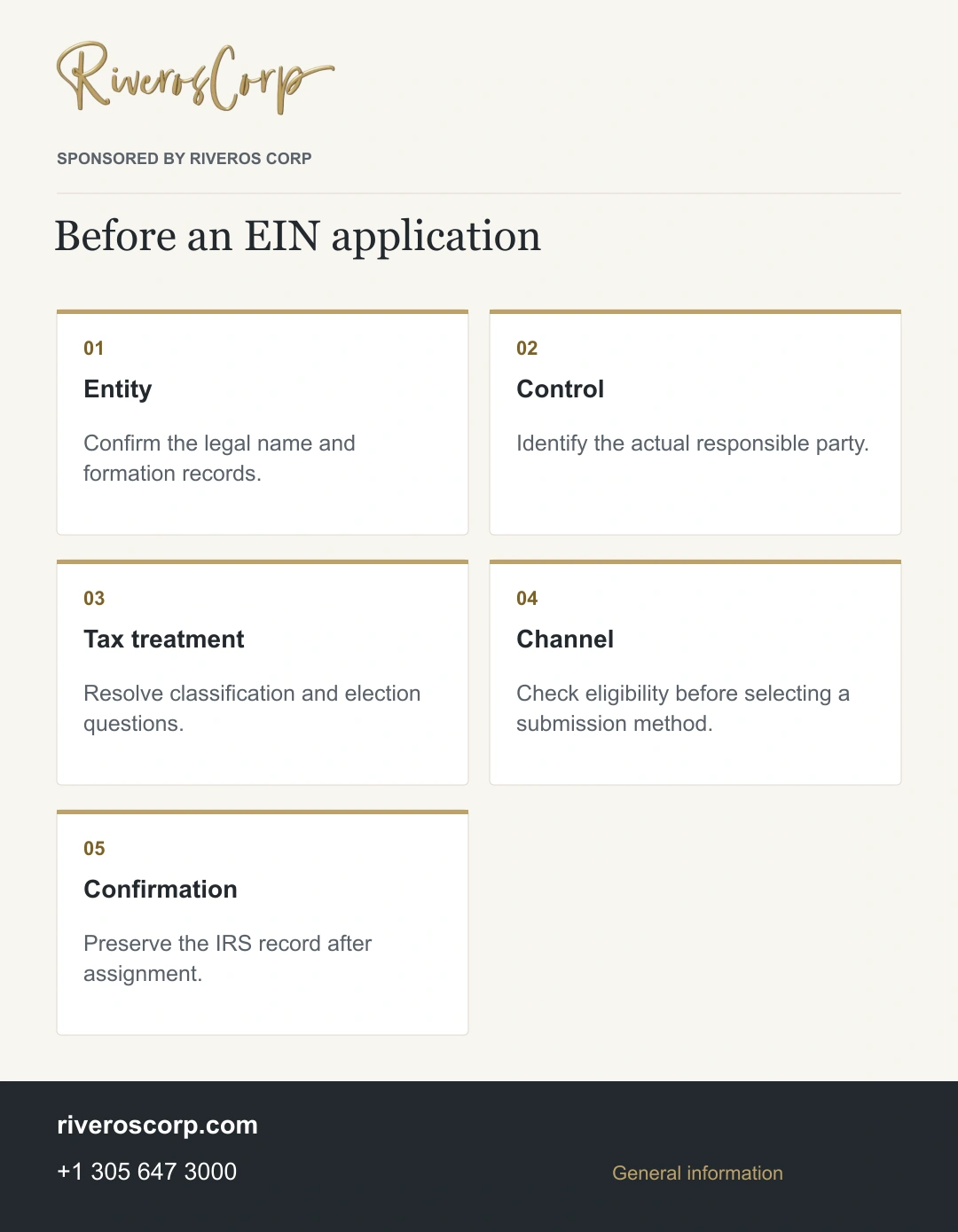
Before preparing an application, assemble the formation records and establish the ownership facts. If tax classification or the identity of the responsible party is uncertain, resolve that issue with a qualified professional first. A nominee who only handles company formation cannot serve as the responsible party in place of the individual who actually controls the entity.
The application method also affects who may submit the request and how the EIN confirmation is delivered. Confirm those arrangements before sharing the business’s information with a third party.
SS-4 instructions begin with the actual applicant
The applicant may be a corporation, partnership, LLC or another type of entity that needs an EIN. The legal name and organizational facts should come from the relevant records, rather than from a marketing name or an abbreviated bank profile.
For a newly formed entity, verify that the formation step has actually been completed where required. A proposed company name, an unsigned operating agreement or an order placed with a filing service may not establish the entity described in the application. Existing entities should also check whether an EIN was already assigned.
Foreign ownership does not make a U.S.-organized entity a foreign entity for every federal tax purpose. The place of organization and tax classification matter. Our guide to whether a foreigner can register a business in the United States explains why formation and owner nationality need separate attention.
Identify the responsible party from control, not convenience
The responsible party is generally the individual who ultimately owns or controls the entity or exercises ultimate effective control over it. IRS instructions provide particular rules and exceptions, including for government entities. Forming the company for a client does not make the service provider its responsible party.
A nominee should not be substituted merely because that person has a U.S. address or taxpayer identification number. Doing so can misstate who controls the business. The actual ownership and control arrangement should be reviewed, particularly when a company has parent entities, managers or several people with different responsibilities.
The responsible party and the person authorized to sign the application are related but distinct questions. A person may have authority to prepare or sign documents without being the individual the IRS requires as responsible party. Keep the underlying authority records and avoid selecting a name solely because it makes a filing channel easier to use.
A foreign responsible party may lack an SSN or ITIN
The SS-4 instructions address a responsible party who has no SSN or ITIN and is ineligible to obtain one. They permit the specified foreign or not-applicable entry in that situation. That rule does not authorize an applicant to invent a number or borrow someone else’s taxpayer identification number.
The important conditions are the responsible party’s actual circumstances and eligibility. A person who already has an appropriate U.S. taxpayer identification number presents a different situation from someone who has never been eligible for one. A preparer should establish the facts instead of treating all foreign owners alike.
This also does not mean every foreign applicant can use the online EIN system. Online eligibility has its own requirements. The absence of an SSN or ITIN should lead to review of the appropriate application channel, rather than replacement of the responsible party with an unrelated U.S. contact.
An LLC’s legal form does not decide every tax answer
LLC describes a state-law entity form. Federal tax treatment may be different. A domestic single-member LLC is generally disregarded for federal income tax purposes unless it elects corporate treatment; a domestic LLC with multiple members generally has partnership treatment unless it elects otherwise.
Those general rules do not answer every entity classification question. Foreign-organized entities have separate classification rules, and elections can alter treatment. The application should reflect the actual structure and relevant tax facts rather than assuming that every business with “LLC” in its name is taxed identically.
An EIN application is not a substitute for a tax election. It also does not establish eligibility for S corporation treatment. Foreign ownership requires particular care because a nonresident alien cannot be an S corporation shareholder. A qualified tax professional should resolve classification and election questions before documents are completed on an unsupported assumption.
Foreign-owned disregarded entities need a separate reporting review
A domestic disregarded LLC wholly owned by a foreign person may have information reporting obligations even when it has no employees or ordinary sales. The SS-4 instructions address EIN requirements connected with that reporting framework.
Receiving an EIN does not tell the owner which annual returns or information forms are required. The business may need review of Form 5472 and a pro forma Form 1120, among other questions. Transactions with the owner, including contributions and distributions, can matter even when the owner describes the company as inactive.
Our discussion of whether a foreigner can open an LLC in the United States provides broader formation context. For the SS-4, the practical point is to identify why the entity needs the EIN and ensure that the tax professional reviewing future obligations receives the same ownership and classification facts.
Describe the actual business activity and reason for applying
The application asks for information about why the EIN is requested and what the business does. Those descriptions should fit the actual entity. A company formed to hold an investment may have different facts from a company beginning an operating business with employees.
Do not choose a business activity because it sounds more attractive to a bank. The IRS application, formation documents and later tax filings should be understandable together. If the business changes after formation, preserve the history and review which records need updating rather than rewriting the initial facts.
Check what each business date represents. Formation, acquisition, commencement of business and first payroll are not necessarily the same event. A preparer should identify which event a particular request concerns. Guessing a date to complete a blank can create discrepancies that later require explanation to the IRS or another institution.
Which EIN application channels are available?
The IRS online system requires a qualifying U.S. or U.S.-territory location and a valid taxpayer identification number for the relevant responsible person. A company’s U.S. formation alone does not resolve every access requirement. Check the actual location and responsible-party facts before choosing the online route.
The telephone route is reserved for international applicants that have no legal residence, principal place of business, or principal office or agency in the United States or its territories. Fax and mail applications follow their own instructions. These are ordinary IRS channels; hiring a filing service does not create a separate government processing route.
Use one application method for each entity. Before resubmitting, establish what was sent, whether the IRS responded and whether a number was already assigned. Keep the signed request and its transmission record. This helps distinguish an unanswered application from a lost confirmation and reduces the risk of duplicate EINs.
A third-party designee has a limited role
The SS-4 third-party designation allows the named person to answer questions about the application and receive the newly assigned EIN. The authorization ends when the IRS assigns the number and releases it to the designee. The IRS mails the EIN notice to the taxpayer even when it releases the number to the designee through another permitted channel.
That authorization is therefore different from permission to handle later tax returns, elections or an IRS examination. A later matter may require a separate authorization and a professional qualified for that work. The applicant’s signature makes the SS-4 designation effective; the designee’s involvement does not change who must be listed as the responsible party.
Keep the signed application and designation with the confirmation notice. The owner should be able to identify the responsible party, the mailing address and the entity information used in the request. If a former provider handled the application, obtain those records before asking a new provider to investigate an apparent missing EIN.
The EIN confirmation record matters after submission
After assignment, preserve the IRS confirmation showing the EIN and the entity name. The completed SS-4 is the request; it is not the same as the IRS’s confirmation that a number was assigned. Banks and other institutions may ask for evidence of the assigned number.
Compare the confirmation with the application and formation records. If a material error appears, obtain appropriate assistance to correct the record. Do not simply edit a scanned IRS notice or create a substitute letter that appears to come from the government.
Our guide to an EIN proof document explains why businesses should keep the official record. Store it with the formation and tax records, and limit unnecessary circulation. An owner who can locate the confirmation is less likely to request a duplicate EIN because the original paperwork is missing.
Changes after assignment require their own review
Form 8822-B reports relevant changes to a business mailing address, location or responsible party. A responsible-party change must be reported within 60 days. These updates do not automatically require a new EIN. Certain changes in ownership or legal structure, however, can require a different number.
The record should show what changed and when: a new business address, a new trade name, a transfer of ownership or formation of a different legal entity. Those events have different consequences. Review the old and new formation and ownership records before replacing a number that may still belong to the same taxpayer.
Riveros Corp’s EIN application service helps prepare the request and preserve the IRS confirmation. Provide the entity’s formation documents, ownership details and any earlier EIN correspondence. Tax classification, elections and annual return obligations remain matters for the qualified tax professional handling the company’s tax position.
Frequently asked questions
Can a foreign owner obtain an EIN without an SSN?
The IRS instructions address applicants whose responsible party lacks an SSN or ITIN and is ineligible for one. The appropriate entries and application channel depend on those facts. This does not permit use of a nominee’s number or guarantee eligibility for the online application system.
Can I complete Form SS-4 online?
The IRS has an online EIN application for eligible applicants. Eligibility includes requirements concerning the business and responsible party. A foreign owner should not assume that the online route is available simply because the company was formed in a U.S. state. Review the current channel requirements before submitting.
Does an EIN application elect corporate taxation for my LLC?
No. Obtaining an EIN and making a tax classification election are separate actions. The application must accurately describe the entity and applicable tax facts, but it does not replace a required election. A qualified tax professional should explain the effect and eligibility requirements of any proposed election.
How long does the IRS take to process an SS-4?
Timing depends on the application channel, processing conditions and whether the information is complete. A provider cannot guarantee a government completion date. Keep the submission record and avoid repeated applications until the status of the first request has been checked through the appropriate process.
Is the submitted SS-4 proof that my EIN was issued?
No. SS-4 is the application. The IRS confirmation establishes the assigned number. Keep both records, and compare the entity name and other identifying details. If confirmation is missing, seek the appropriate IRS documentation rather than applying for another EIN solely to replace lost paperwork.
Prepare your EIN records with Riveros Corp
Contact Riveros Corp at +1 305 647 3000 or through WhatsApp to discuss EIN document preparation and confirmation records. Bring the formation and ownership information, and have tax classification questions reviewed by a qualified tax professional.
By Zulma E Bourelly. General information only. Individual legal and tax questions require advice from an appropriately qualified professional.