

A politically exposed person, or PEP, is someone associated with a prominent public function under the framework being applied. Financial institutions use the concept when assessing risks connected with corruption and money laundering. PEP status is not a criminal accusation or proof that a person’s funds are unlawful.
Check which definition the institution applies. International standards discuss foreign, domestic and international organization PEPs, while U.S. banking rules use particular legal terms for particular obligations. A bank’s internal screening label should not be treated as a universal legal conclusion that applies identically in every country.
If a bank asks about a public role or a relationship with an official, the useful response is accurate documentation. Establish the person’s identity, the actual role, relevant dates and the source of the funds involved. A name appearing in a screening result is a reason to examine the facts, not a reason to presume misconduct.
What politically exposed person means in context
International anti-money laundering standards use the PEP concept for individuals entrusted with prominent public functions. The framework also considers family members and close associates. The purpose is to address risks associated with access to public authority and possible misuse of that authority.
FATF guidance distinguishes foreign PEPs, domestic PEPs and people with prominent functions in international organizations. Those categories help define the applicable approach, but national law and institutional policy determine the requirements in a particular setting.
In the United States, the FFIEC banking examination guidance notes that Bank Secrecy Act regulations do not contain a general PEP definition or a single set of PEP-specific requirements. The separate rules for senior foreign political figures in specified private banking accounts must be distinguished. A review should identify which legal or policy definition it is using before classifying a person.
Public responsibility does not establish wrongdoing
A person can hold a prominent public office and conduct entirely legitimate financial activity. The same is true of a family member or business associate. Screening is a preventive risk-management process; it is not a determination that an offense occurred.
U.S. supervisory guidance emphasizes that no particular customer type automatically presents higher risk in every case. Banks assess the circumstances of the relationship, including products, services, transactions and geographic factors. A customer’s public role is one relevant fact within that assessment.
This distinction should appear in the language used by a report or service provider. Describing someone as “corrupt” because a database labels them a PEP is unsupported. A careful report identifies the source, role and applicable definition, then explains any unresolved facts without converting a screening category into an allegation.
U.S. senior foreign political figure rules are narrower
The U.S. private banking rules define a senior foreign political figure more specifically. The definition includes current or former senior foreign government officials, senior officials of major foreign political parties and senior executives of government-owned commercial enterprises. A senior role involves substantial authority over policy, operations or public resources; employment by a government alone does not establish it.
The definition also reaches entities formed by or for those officials, specified immediate family members and known close associates. Immediate family includes a spouse, parents, siblings, children, and the spouse’s parents and siblings. These are the relationships in this U.S. rule; another jurisdiction or bank policy may use a different definition.
For accounts meeting the regulatory definition of private banking, a senior foreign political figure’s nominal or beneficial ownership triggers enhanced scrutiny for possible proceeds of foreign corruption. An ordinary account does not become subject to that particular rule merely because the bank calls its service private banking. The account must meet the regulatory criteria.
Family relationships and close associations need evidence
Some frameworks extend scrutiny to family members and close associates because those relationships can be relevant to the movement or ownership of funds. The scope depends on the applicable definition. It should not be assumed that every distant relative or casual acquaintance is treated identically.
A review should establish the relationship rather than infer it from a shared surname, photograph or unverified online claim. Names can be common, family relationships can be misstated and business associations can change. The source and date of the information matter.
Where a relationship is relevant, explain its nature and connection to the customer or transaction. A company ownership record may establish one kind of association; a social reference may not establish the same facts. Avoid attaching a sensitive label to a person without identifying the evidence and the definition that make the relationship relevant.
A screening match needs identity verification
Automated screening can return people with similar names, alternate spellings or incomplete biographical information. The first task is to determine whether the result concerns the customer. A match on a name alone may be insufficient.
Useful identifiers can include the public role, jurisdiction, relevant dates and other reliable biographical details. The reviewer should compare information from trustworthy sources and record why a match was confirmed or rejected. A commercial database entry should not be treated as infallible simply because it appears in a formal report.
Our discussion of due diligence versus a background check explains why finding a record and evaluating its relevance are different tasks. For PEP screening, the final conclusion should describe the verified connection and any remaining uncertainty, rather than copying a search result as though it were a judgment.
Source of funds and source of wealth answer different questions
An institution may ask how the funds in a particular transaction were obtained and how the person accumulated their broader wealth. These are related but distinct inquiries. A bank statement showing a transfer may establish the route of funds without explaining their underlying origin.
Supporting records should fit the explanation. Employment income, a business sale, inheritance and investment proceeds involve different documents. The explanation should show how the person obtained the money, with records connecting the source to the payment under review.
The institution determines what it needs under its applicable obligations and risk assessment. A customer should ask for clarification when a request is unclear and avoid submitting unrelated sensitive records indiscriminately. Keep the explanation consistent across the application, ownership records and supporting documents so the reviewer can understand the transaction.
Beneficial ownership can connect the person to an entity
A customer may be a company rather than an individual. The review can still require understanding who owns or controls the company and whether a relevant public official, family member or associate has a connection to it.
Corporate records should show the actual ownership chain and control arrangements. An intermediate company does not necessarily answer who ultimately owns or controls the customer. At the same time, a director’s name should not be treated as proof of ownership without examining the relevant role.
Our guide to customer due diligence requirements explains the broader purpose of identity and ownership information. PEP-related review builds on those facts. It should preserve the difference between legal ownership, beneficial ownership, management authority and an external relationship with a public figure.
Enhanced review should respond to the actual risk
U.S. customer due diligence rules do not require banks to screen every customer for PEP status. FFIEC guidance expressly makes that distinction. Banks may use PEP screening within their risk programs, while the separate private banking rule imposes specific duties for accounts within its scope. A commercial screening product does not create an additional legal obligation by itself.
The bank assesses the public role alongside the account’s purpose, products, transaction patterns and geographic connections. Access to public assets or an explanation of wealth that conflicts with known employment may warrant closer examination. A documented private business, consistent income and a clear transaction history provide different facts to assess.
Our explanation of enhanced due diligence discusses additional evidence. The review should connect each request to an unresolved issue: an ownership link, an unexplained transfer or a gap in the account history. This gives the customer a practical way to respond and leaves a record of why further scrutiny was needed.
Leaving office does not create one universal cutoff
A former public role can remain relevant after the person leaves office. The applicable law, guidance and institutional policy determine how the relationship is assessed. There is no single global rule under which every former official loses every PEP-related classification after the same period.
The review should record when the role began and ended, whether influence or relevant connections remain and what the applicable framework requires. An old database label may need updating, but the end of an appointment does not justify silently deleting accurate historical information.
Customers can provide reliable evidence correcting an outdated role or a mistaken identity. The institution then evaluates that information under its procedures. A correction should identify which source was outdated and when the replacement information was checked. Different institutions may maintain separate records, so keep the correction and its supporting evidence available for later inquiries.
Prepare a factual response to a bank request
Read the bank’s written request first. Identify the person, entity or transaction it wants explained. A short chronology can connect the dates of public office, business ownership and the payment under review. Attach records that establish those points and identify any information that is still missing.
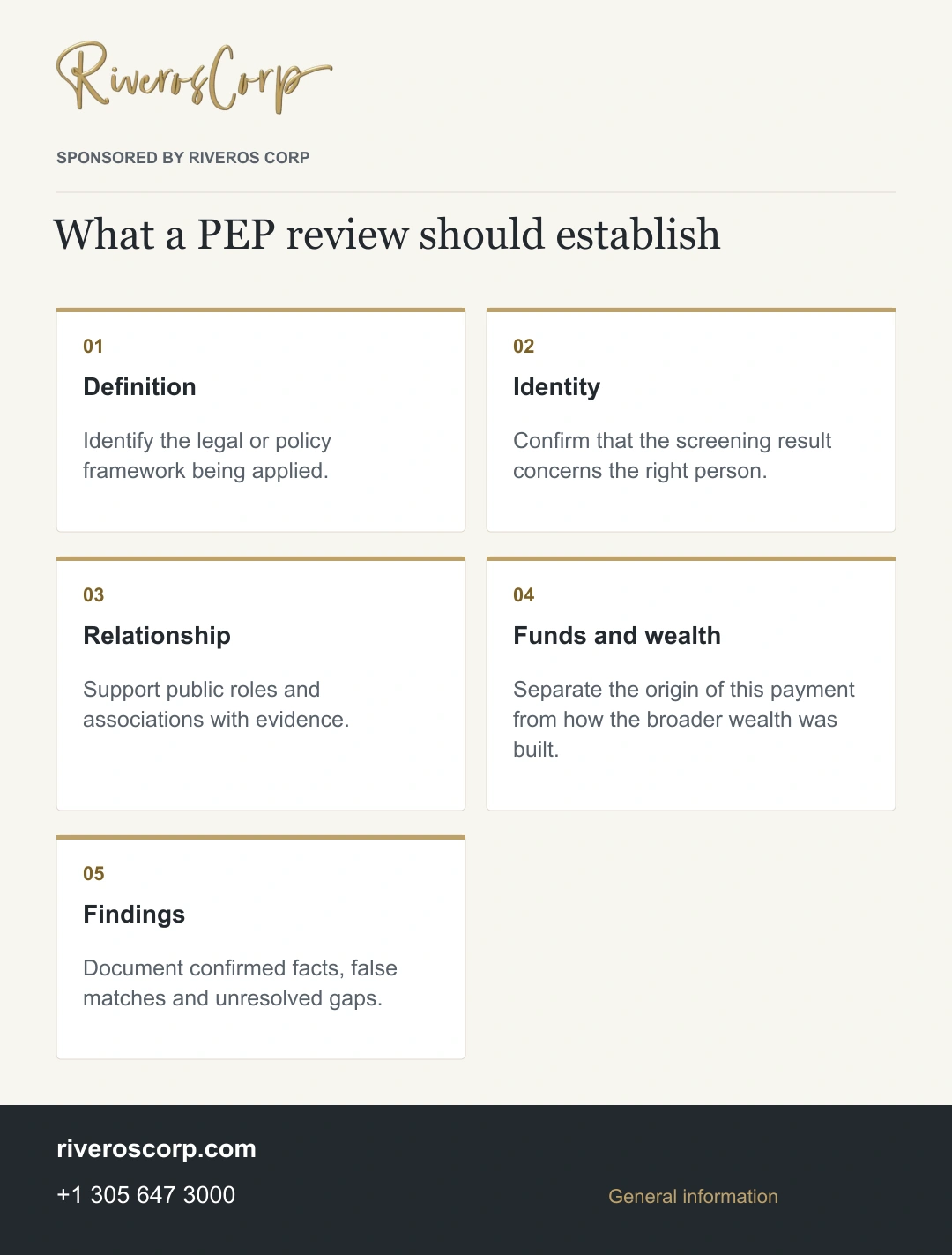
Riveros Corp’s enhanced due diligence service includes PEP and close-associate review, analysis of identifying information and documentation of the source of funds and wealth. Its report records findings, reasons for clearing false matches and unresolved gaps. The engagement can also set a review schedule and identify changes that call for an earlier check.
For a mistaken identity, explain exactly which identifiers differ and retain the source used to check them. For a confirmed public role, document its jurisdiction, responsibilities and dates. Riveros provides the review findings; the bank or business makes its own acceptance decision under its policy and applicable obligations.
Frequently asked questions
Does being a PEP mean someone is suspected of a crime?
No. PEP status concerns a public role or relevant relationship under an applicable framework. It does not establish corruption, money laundering or any other offense. A report should distinguish verified biographical facts from allegations and should not infer wrongdoing from the screening category alone.
Is every government employee a politically exposed person?
Not automatically. Definitions focus on specified prominent functions and relationships, and they vary by legal framework. A job title should be reviewed in context. The person’s responsibilities, seniority and the applicable definition matter more than the fact that the employer is a government body.
Can a bank serve a politically exposed person?
Yes. U.S. supervisory guidance permits banks to serve PEP customers and does not classify every such customer as high risk. The bank evaluates the relationship under its program. Specific private banking requirements apply when the account and its owners meet the relevant regulatory definitions.
Can a name match be wrong?
Yes. Similar names, alternate spellings and incomplete information can produce false matches. The reviewer should compare reliable identifiers and document the reason for confirming or rejecting the result. A name alone should not be converted into a definitive statement about someone’s public role or relationships.
Does leaving office automatically end PEP treatment?
There is no universal cutoff. The reviewer considers the applicable framework, the dates of office and any continuing influence or relevant connections. Evidence of a departure from office can correct an outdated current-role description while preserving an accurate record of the former position.
Request a documented PEP review
Contact Riveros Corp at +1 305 647 3000 or through WhatsApp to discuss the person or counterparty being reviewed. The team can define the scope of the identity, public-role, ownership and source-of-funds review and identify the records it needs.
By Zulma E Bourelly. General information only. Individual legal and tax questions require advice from an appropriately qualified professional.